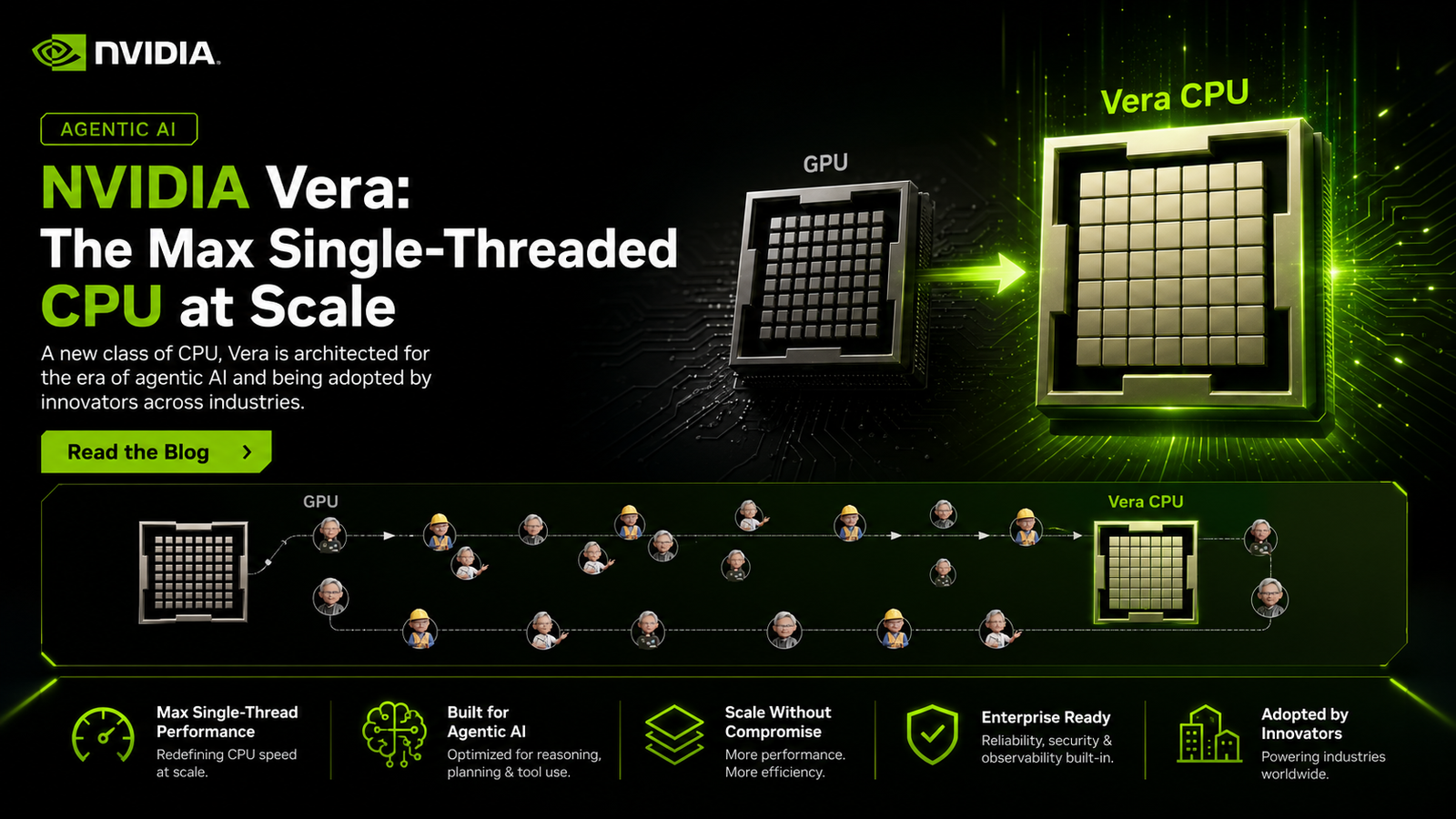
Why the Agentic AI Era Forced NVIDIA to Build Its Own CPU
NVIDIA’s custom 88-core Vera CPU shatters x86 data center design, prioritizing single-threaded power to cure the silent killer of agentic AI.

If you’ve spent any time looking at data center architecture over the last decade, you’ve probably noticed a distinct trend: a massive, relentless race for core density. Processor giants have been stuffing more and more cores onto single slivers of silicon, trading off individual core speed (single-threaded performance) to win the multi-threaded throughput game. It made perfect sense for traditional cloud computing, where hosting thousands of isolated micro-services or web servers was the name of the game.
But then, AI grew up.
We moved from simple, single-prompt large language models (LLMs) to complex, multi-agent AI ecosystems, autonomous systems that don’t just spit out the next word, but actually stop to plan, write and compile code, call external APIs, and spin up sandboxed environments to test their own work.
Suddenly, the modern data center ran into a brick wall. This new wave of “agentic AI” doesn’t just run on GPUs. It relies heavily on a sequential, step-by-step logic loop that can only be handled by a CPU. And when that CPU is optimized for density rather than raw, unadulterated single-threaded speed, your multi-million-dollar GPU cluster spends half its life doing the absolute worst thing it can do: sitting completely idle, waiting for the CPU to finish its homework.
Enter NVIDIA Vera. Unveiled as a cornerstone of the next-generation Vera Rubin platform, Vera is a fundamentally different beast. It is NVIDIA’s first-ever server processor built entirely on its own custom-designed Arm silicon, a powerhouse designed specifically to be the ultimate single-threaded CPU at scale.
The Invisible Bottleneck: The Agentic Loop
To understand why Vera exists, we have to look at what actually happens under the hood when a modern AI agent goes to work.
When you ask an AI developer agent to “fix a bug in this GitHub repository,” the GPU executes the neural network math to decide what to do. But once it decides to run a test, the GPU hands the heavy lifting off to the host CPU.
The CPU must then:
- Spin up a secure, sandboxed container.
- Clone the codebase.
- Run the compiler and execute the test suite.
- Feed the text results back to the GPU.
This sequential chain is called the agentic inner loop. Because step B cannot start until step A is finished, this workload is highly single-threaded. No amount of multi-core parallelism can speed up a single thread of logic that is physically waiting on a compiler to finish.
On a standard, high-density server CPU, this process is painfully slow. While the CPU struggles through the code execution, those massively expensive GPUs are trapped in a state of “loaded latency,” waiting for their next batch of data.
Inside the Silicon: How Vera Achieves Max Single-Threaded Scale
Rather than licensing off-the-shelf processor designs, NVIDIA spent years engineering a custom Arm core code-named Olympus. The Vera CPU packs 88 of these custom Olympus cores onto a massive, monolithic compute die.
By focusing relentlessly on single-threaded execution rather than raw core-count marketing, NVIDIA built a processor that delivers 1.8x faster sustained per-core performance under full socket load compared to traditional x86 data center CPUs.
Several key architectural breakthroughs make this possible:
1. The Power of One Monolithic Die
Traditional modern CPUs rely on a “chiplet” design, stitching multiple smaller silicon dies together on a single package to save manufacturing costs. The downside? When a core on Chiplet A needs data from Chiplet B, it has to travel across a physical boundary, creating massive latency spikes.
Vera completely bypasses this issue by utilizing a monolithic compute die. All 88 Olympus cores sit on a single piece of silicon, tied together by a lightning-fast, ultra-wide Scalable Coherency Fabric (SCF) that pumps out an astonishing 3.4 TB/s of core-to-core bandwidth. This design keeps latency predictable and incredibly low, achieving a 40% reduction in peak loaded latency compared to x86 chips.
2. Eliminating the Memory Wall with LPDDR5X
An incredibly fast core is useless if it is constantly starving for data. To feed the Olympus cores, Vera implements a massive LPDDR5X memory subsystem.
Instead of traditional server memory, Vera delivers up to 1.2 TB/s of total memory bandwidth. This translates to roughly 14 GB/s of bandwidth per core, more than triple the per-core memory bandwidth of standard x86 server chips, all while consuming less than half the power. This ensures that even when all 88 cores are actively running heavy sandboxed environments, none of them run out of memory runway.
3. Spatial Multithreading (SMT)
Standard hyper-threading on consumer and server CPUs relies on “time-slicing”, rapidly swapping a single core’s attention back and forth between two threads. If one thread stalls, both suffer.
Vera introduces NVIDIA Spatial Multithreading. Instead of sharing everything, SMT physically partitions the internal resources of the Olympus core. This creates 176 independent threads that can execute simultaneously with absolute predictability. For multi-agent systems scaling out to thousands of parallel tasks, this translates to zero-lag performance.
Real-World Impact: The Perplexity Case Study
If this all sounds like academic posturing, the early real-world deployment data proves otherwise. AI search innovator Perplexity became one of the first major tech firms to adopt NVIDIA’s Vera architecture for their multi-agent AI coding stacks.
When Perplexity tested Vera against leading x86 server alternatives on actual, real-world coding agent workflows, specifically cloning code repositories and running deep test suites in isolated sandboxes, the results were stark:
- 1.5x faster overall coding workflow completion.
- Up to 1.9x faster concurrent sandbox startup times.
Outside of code execution, database platforms like Starburst measured up to 3x faster SQL analytics, while streaming data platforms like Redpanda saw latency drop by a staggering 6x.
By compressing the time the CPU spends orchestrating, running tools, and handling key-value (KV) caches, Vera essentially keeps the data highway clear. The direct result? GPUs stay fully utilized, token generation costs plummet, and AI factories generate far more revenue per dollar of infrastructure spend.
The Co-Designed Future
The magic of Vera isn’t just that it is a stellar standalone CPU; it’s how it behaves as part of a larger ecosystem.
When paired with NVIDIA’s next-generation Rubin GPUs in a rack-scale system like the Vera Rubin NVL72, the CPU and GPU are linked by an ultra-fast NVLink-C2C interconnect. This link provides a mind-boggling 1.8 TB/s of coherent, bidirectional bandwidth—nearly double the bandwidth of the previous Grace-generation chip.
This coherent link creates a unified memory pool. The CPU can seamlessly offload memory-heavy KV-caches directly to the GPU, and the GPU can call upon the CPU to execute rapid tool functions without the massive performance penalties associated with traditional PCIe lanes.
Conclusion: A New Philosophy for Silicon
For decades, the data center industry has looked at the CPU as a general-purpose, catch-all calculator where “more cores” equaled a better product. NVIDIA’s Vera completely flips this script.
By recognizing that the next frontier of AI is not just about raw model size, but about the execution speed of the autonomous agents running on top of them, NVIDIA has designed a chip where single-threaded speed, low latency, and memory bandwidth are the ultimate metrics of success.
Vera proves that in the age of agentic AI, the host CPU is no longer just background infrastructure. It is the head chef of the AI factory, and with custom Olympus silicon, that chef has never moved faster.