Optical Revolution Results in NVIDIA and Cisco’s Breakthrough Infrastructure Alliance
Hardware giants NVIDIA and Cisco unite to launch USFP, an open pluggable optical standard designed to power next-generation 800G AI superclusters

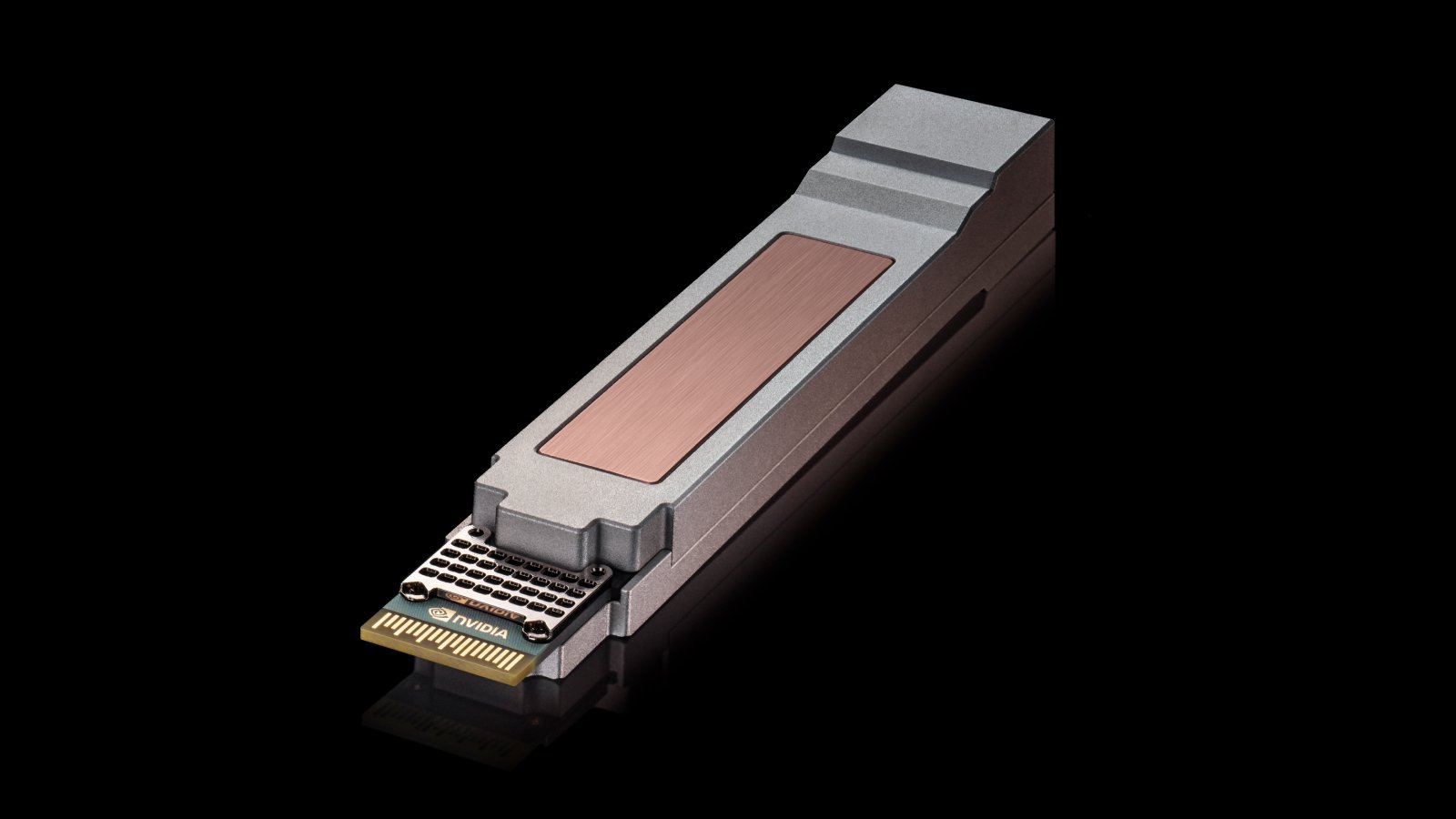
Image Credits: NVIDIA
The artificial intelligence boom has reached a crucial mechanical wall. While frontier labs continue to scale model parameters into the trillions, data center architects are grappling with a far more physical constraint: the copper wire bottleneck. As hyperscale training clusters expand across thousands of interconnected GPU nodes, traditional electrical interconnects generate unsustainable thermal loads and signal degradation.
To break through this hardware ceiling, industry titans NVIDIA and Cisco have announced a strategic infrastructure partnership. Unveiled alongside optical interconnect leaders TE Connectivity and Amphenol, the alliance establishes an open, multi-source hardware ecosystem surrounding USFP (Ultra Small Form-factor Pluggable) optics.
Engineered specifically to scale next-generation “AI Gigafactories,” this unified optical specification promises to slash data center energy overhead while dramatically accelerating chip-to-chip bandwidth across high-density computing clusters.
1. The Physics Wall: Why Copper Is Dying in AI Superclusters
Building a modern AI training cluster is no longer just a challenge of placing silicon onto server boards; it is a complex fluid-dynamics and signal-integrity problem. When training multi-modal foundation architectures, thousands of GPUs must exchange intermediate weights, attention matrices, and gradient updates simultaneously with microsecond synchronization.
Historically, server racks relied on passive direct-attach copper (DAC) cables to link adjacent graphics processors. However, at speeds exceeding 800 Gigabits per second (800G) per port, copper cables exhibit severe electrical attenuation over distances as short as two meters.
To compensate for signal loss, networking switches must pump massive amounts of power into active retimers, creating a thermal death spiral where up to 30% of a rack’s total power consumption is wasted solely on moving data across physical wires.
2. Unpacking USFP: The Architecture Behind the Optics
The newly unveiled USFP standard directly addresses this bandwidth-per-watt deficit by shifting photonics straight to the edge of the compute board.
Co-developed by Cisco and NVIDIA alongside tier-one connector manufacturers, USFP merges ultra-high-density optical transceivers into a pluggable form factor that is roughly half the physical footprint of legacy QSFP-DD modules.
Core Architectural Breakthroughs
- Direct Silicon-to-Photon Conversion: By integrating optical engines closer to the GPU substrate, USFP minimizes the electrical trace distance data must travel over copper PCB, cutting transmission power draw by up to 40%.
- Hot-Swappable Reliability: Unlike fragile Co-Packaged Optics (CPO) that permanently bond optical lasers inside the main processor package, requiring an entire $30,000 GPU assembly to be scrapped if a single laser fails, USFP retains a modular, pluggable architecture. System administrators can instantly swap out degraded optical modules without interrupting compute cluster uptime.
- Density Compression: The ultra-small form factor allows hardware engineering teams to pack up to 64 optical ports into a single 1U switch chassis, doubling the interconnect density of high-speed AI fabric switches.
3. High-Density Hardware Comparison
To understand how USFP compares against legacy networking fabrics deployed across current enterprise data centers, consider the following structural specifications matrix:
| Architectural Metric | Legacy Copper (DAC 800G) | Standard Optical (QSFP-DD) | NVIDIA-Cisco USFP Standard |
| Maximum Reach | $\le 2.0$ Meters | Up to 100+ Meters | Up to 500+ Meters |
| Power Consumption per Port | ~18 Watts (Active) | ~14 Watts | $\le 8.5$ Watts |
| Physical Module Volume | Large / Rigid Form | Standard Footprint | 50% Reduced Footprint |
| Thermal Efficiency | Poor (High Passive Resistance) | Moderate | Optimal (Direct Heat-Sink Mounting) |
| Multi-Vendor Ecosystem | Fragmented Proprietary | Open Industry MSA | Open Community MSA |
4. Operational & Regulatory Impact on Global AI Infrastructure
The release of the USFP open specification arrives at a pivotal moment for global technology infrastructure. Governments and enterprise organizations are increasingly monitoring the carbon footprint and energy draw of mega-scale computing sites.
Simultaneously, international regulatory bodies, such as ministers in the UK exploring compulsory reporting for AI infrastructure incidents, are placing tighter operational demands on system stability. By switching to lower-wattage optical backbones like USFP, operators can pack twice as much training throughput into existing power grid allocations while minimizing thermal failure rates across mission-critical clusters.
The Verdict: Setting the Stage for 1.6 Terabit Networking
The alliance between NVIDIA, Cisco, TE Connectivity, and Amphenol signals a clear industry consensus: the future of high-performance artificial intelligence is fundamentally optical.
By establishing an open, multi-source hardware community around USFP, these tech giants are laying the physical foundation for the upcoming 1.6 Terabit networking generation. For enterprise organizations and cloud service providers alike, the shift to pluggable optics isn’t just an incremental hardware update, it is the indispensable backbone that will power the next era of autonomous, multi-agent AI supercomputing.
For additional coverage on data center silicon and enterprise computing developments, explore our tech breakdowns over at the ForanTech Infrastructure Hub. To review the official technical whitepapers and open specifications, visit the Cisco Newsroom Release.