The Pentagon’s New AI Factory: NVIDIA Liquid-Cooled Breakthrough at Monterey
The U.S. military deploys its first liquid-cooled NVIDIA Grace Blackwell Ultra supercomputer at Monterey to accelerate autonomous warfare simulations.

MONTEREY, CA, The balance of military technological advantage is shifting away from pure kinetic horsepower to processing speed, data synthesis, and cognitive readiness. In an era where the timeline between observation and action must compress down to seconds, the U.S. military just flipped the switch on its most sophisticated computational engine yet.
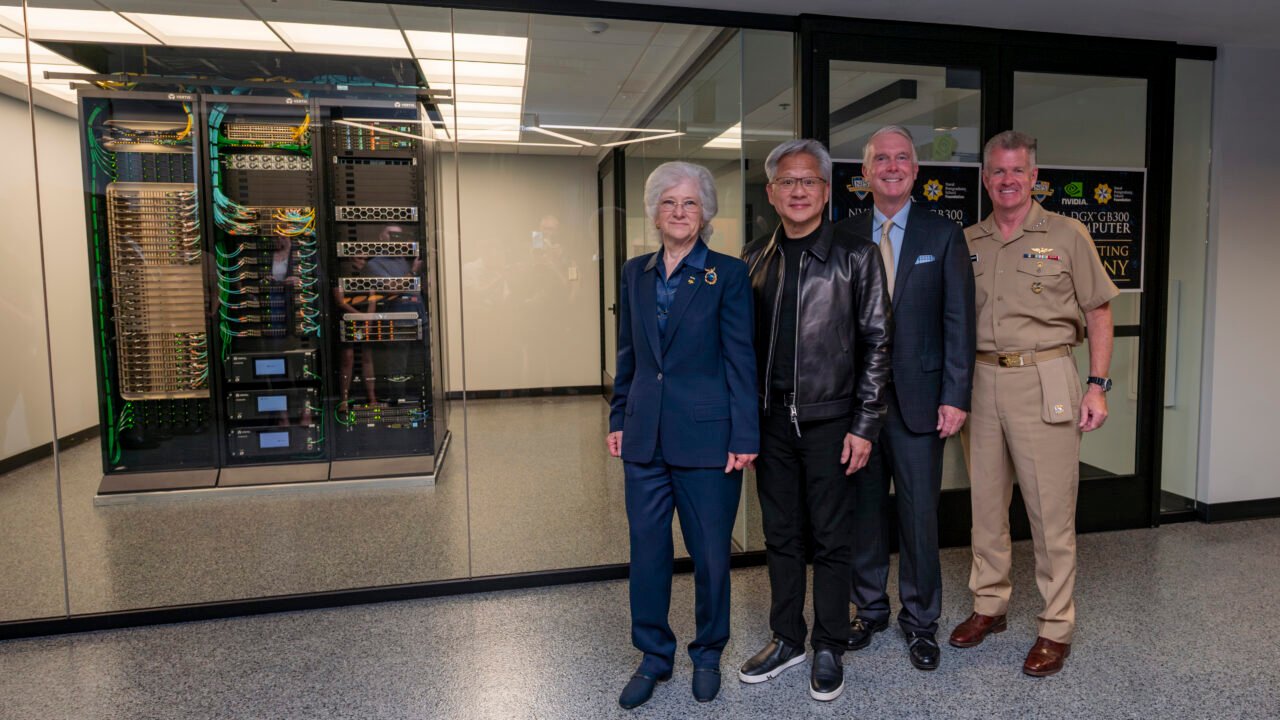
At the historic Naval Postgraduate School (NPS) campus in Monterey, California, NVIDIA founder and CEO Jensen Huang joined Admiral Samuel Paparo, commander of the U.S. Indo-Pacific Command, and NPS President Retired Vice Adm. Ann Rondeau to officially commission the NVIDIA DGX GB300. The deployment marks a watershed moment: the first direct installation of NVIDIA’s flagship, rack-scale Grace Blackwell Ultra platform anywhere within the American military ecosystem.
Rather than navigating the traditional, notoriously sluggish defense procurement machine that can take years to approve legacy systems, this estimated $15 million supercomputer bypassed standard red tape entirely. The second physical unit off NVIDIA’s assembly line, the machine was donated directly to the non-profit NPS Foundation. By routing the deployment through a Cooperative Research and Development Agreement (CRADA) first initiated in late 2024, the hardware skipped competitive-bid bureaucracy to establish a localized “AI factory” overnight. The system grants more than 1,500 in-resident military students and 600 specialized faculty immediate on-premises access to frontier compute power previously restricted to massive commercial tech clouds.
The Architecture: 72 GPUs, One Memory Domain
The DGX GB300 is an engineering marvel packaged into a single, high-density, liquid-cooled rack. In legacy supercomputers, scaling up meant clustering individual server blades together across physical switches, resulting in data bottlenecks as chips waited for information to travel across copper cables. The GB300 radically alters this dynamic.
At its core, the machine utilizes a massive fifth-generation NVLink interconnect fabric to wire together 72 Blackwell Ultra GPUs and 36 Grace CPUs (packing 2,592 total Arm cores). This massive web of silicon behaves not as an array of discrete parts, but as a single, colossal, unified memory domain. The system acts like a single massive GPU with ~20 terabytes of High-Bandwidth Memory (HBM) directly accessible at blisteringly low latencies. Backed by 800 Gb/s InfiniBand (ConnectX-8) networking, the cluster delivers a staggering 1.44 Exaflops of sparse FP4 AI compute.
Bringing this immense thermal footprint online within a historic, campus environment required a highly coordinated infrastructure strategy. A single Blackwell rack draws massive amounts of power and outputs intense, concentrated heat. To handle this, data infrastructure specialists stepped in to wrap the rack in an advanced supporting ecosystem:
- Vertiv engineered a custom thermal management layout featuring liquid-to-liquid heat exchangers, precise fluid management, and direct-to-chip cooling loops capable of carrying away heat generated at full operational load.
- DDN and VAST Data provided a highly specialized, unified data architecture to feed the ravenous data demands of the system, implementing roughly half a petabyte of ultra-fast shared AI storage.
- Dell Technologies and Sterling Computers supplied the vital surrounding infrastructure required to safely isolate and run workloads across unclassified, controlled unclassified, and classified security tiers.
Weapons of Intellect: What NPS is Building
The strategic value of this deployment hinges on security. Because the DGX GB300 runs locally on campus using NVIDIA Mission Control software rather than sending tokens up to a commercial cloud provider, researchers can safely expose it to sensitive, proprietary defense datasets without risking leaks.
The school’s newly minted AI Technology Center has mapped out an ambitious, applied research portfolio targeting four core defense challenges:
1. High-Resolution Micro-Climate & Ocean Modeling
Standard global meteorological frameworks often rely on coarse 50-kilometer data grids. For a naval commander planning an amphibious landing, launching small-boat special operations, or routing a carrier strike group through a typhoon, 50 kilometers is far too broad. NPS researchers are leveraging the extreme high-throughput inference of the GB300 to process massive satellite, radar, and ocean buoy data streams in real time. The goal is to output ultra-localized, physics-informed weather, surf, and atmospheric predictions down to a microscale resolution.
2. Autonomous & Multi-Agent Tactics
The future of maritime denial relies heavily on mass, specifically, distributed webs of low-cost, uncrewed platforms. Training neural networks to coordinate thousands of independent aerial, surface, and subsurface drone fleets requires intense computational heavy lifting. The GB300 allows researchers to run large-scale reinforcement learning loops and multi-agent simulations, enabling autonomous systems to dynamically learn fleet tactics, swarming behaviors, and counter-adversarial maneuvers through continuous self-play.
3. “NPS GPT” Sovereign Foundation Models
Modern military planning involves parsing mountains of text, tracking data, complex logistics schedules, and signals intelligence. NPS is utilizing its on-premise compute power to train domain-specific large language models and multimodal foundation systems (integrating text, imagery, and cyber signals). Dubbed “NPS GPT,” these isolated networks are explicitly tailored to navigate maritime command structures and C5ISR-T (Command, Control, Computers, Communications, Cyber, Intelligence, Surveillance, Reconnaissance, and Targeting) environments.
4. Physics-Based Maritime Digital Twins
Through an expanded framework built on NVIDIA Omniverse libraries and co-developed with the non-profit MITRE corporation, NPS is constructing exact, real-time digital twins of operational environments, naval assets, ports, and critical supply infrastructure. These virtual environments allow commanders to stress-test systems, simulate navigation under severe weather anomalies, and execute AI-assisted wargaming scenarios against aggressive “Red Team” algorithms before deploying real-world resources.
The Strategic Trade: Why Nvidia Gave it Away
The economics of the transaction underscore a deliberate, mutually beneficial arrangement. For the Naval Postgraduate School, receiving a frontier supercomputer for free enables them to bypass a multi-year acquisition cycle, keeping them on the absolute bleeding edge of commercial innovation. To maximize the system’s impact, the NPS Foundation has even committed up to $2 million in auxiliary funding to staff the cluster with dedicated technicians and industry mentors.
For NVIDIA, the donation serves as a direct pipeline into the defense sector. While the silicon giant deeply understands enterprise, hyperscale, and commercial cloud deployments, it historically has had limited visibility into the highly specialized, data-denied, and deeply classified use cases specific to military operations. By embedding its top-tier enterprise system within a defense university for a multi-year runway, NVIDIA secures a front-row seat to view how its hardware handles the most demanding, unconventional software pipelines in national security.
Cultivating the Next Generation of Requirements
Ultimately, the primary return on this investment is cultural rather than structural.
“The changing character of warfare impacts the entire spectrum of conflict,” noted Admiral Samuel Paparo during the system’s commissioning. “To achieve absolute decision superiority, we must leverage data, compute, and human-machine integration to observe, orient, decide, act, assess, learn and adjust faster than any adversary.”
By embedding an AI factory into the core curriculum of mid-career military officers—the Navy lieutenants, Marine captains, and Joint Force planners who come to NPS with combat experience—the school is building a unique cognitive advantage. These officers will return to active fleets not just as users of technology, but as AI-literate commanders who thoroughly understand its limits, safety parameters, and tactical opportunities.
As NPS President Ann Rondeau concluded, technology alone is not a silver bullet: “Enduring advantage has never depended on technology alone, it depends on leaders with the intellect, wisdom and judgment first to deter conflict and, when necessary, fight decisively.” The DGX GB300 is the tool; the active-duty minds in Monterey are the weapon.