The Desktop Revolution: PlayStation’s New Ecosystem
Sony shifts from the couch to the desk with a premium, high-refresh ecosystem designed to bridge console and PC gaming.

Image credit: Playstation.Blog
For over three decades, the PlayStation brand has been tightly bound to a specific cultural image: the living room. It was an experience anchored to the couch, a sprawling television, and a singular console tucked neatly inside a media cabinet. However, a major strategic shift is unfolding. Sony is aggressively breaking out of the traditional living room mold. With the rollout of a cohesive wave of desktop-focused hardware and peripherals, Sony is signaling a massive corporate pivot: the creation of a dedicated PlayStation Desktop Ecosystem.
This hardware push directly targets the growing demographic of players who prefer a personal desktop setup, blending the console world seamlessly with high-end PC gaming architecture. As Sony brings more of its first-party catalog to PC and prepares its infrastructure for the next generation of play, the desktop has transformed from an adjacent market into a primary battleground.
1. The Visual Hub: The 27-Inch PlayStation Gaming Monitor
At the literal and symbolic center of this new ecosystem is a hardware first—an official, PlayStation-branded 27-inch QHD gaming monitor. Retailing at $349.99 USD, this display is meticulously engineered to bridge the gap between console optimization and high-end PC performance, acting as a dual-purpose crown jewel for any modern desk setup.
Dual-Platform Fluidity
The monitor utilizes a crisp 2560×1440 In-Plane Switching (IPS) panel that strikes the ideal balance of pixel density and performance for desktop viewing distances. It boasts a 95% DCI-P3 wide color gamut and robust Variable Refresh Rate (VRR) support. While it perfectly matches the PS5 and PS5 Pro capabilities by capping at a fluid 120Hz with exclusive Auto HDR Tone Mapping features, it allows PC and Mac users to unlock its true ceiling: a blazing-fast 240Hz refresh rate via DisplayPort 1.4 or HDMI 2.1.
Ergonomic Desktop Integration
Proving that this display was explicitly built for close-quarters desk setups rather than a distant entertainment center, Sony built utility directly into the physical industrial design. The monitor stand features an integrated, low-profile DualSense Charging Hook directly beneath the panel. This provides a neat, functional home for controllers right at your workstation, charging the gamepad via the monitor’s internal power supply even when the display is sleeping.
With two HDMI 2.1 ports, a DisplayPort 1.4 connection, and an integrated USB hub (including USB Type-C), it functions as a highly capable KVM-style desktop environment where swapping between a work computer and a gaming rig takes a single click.
2. Competitive Control: The FlexStrike Wireless Fight Stick
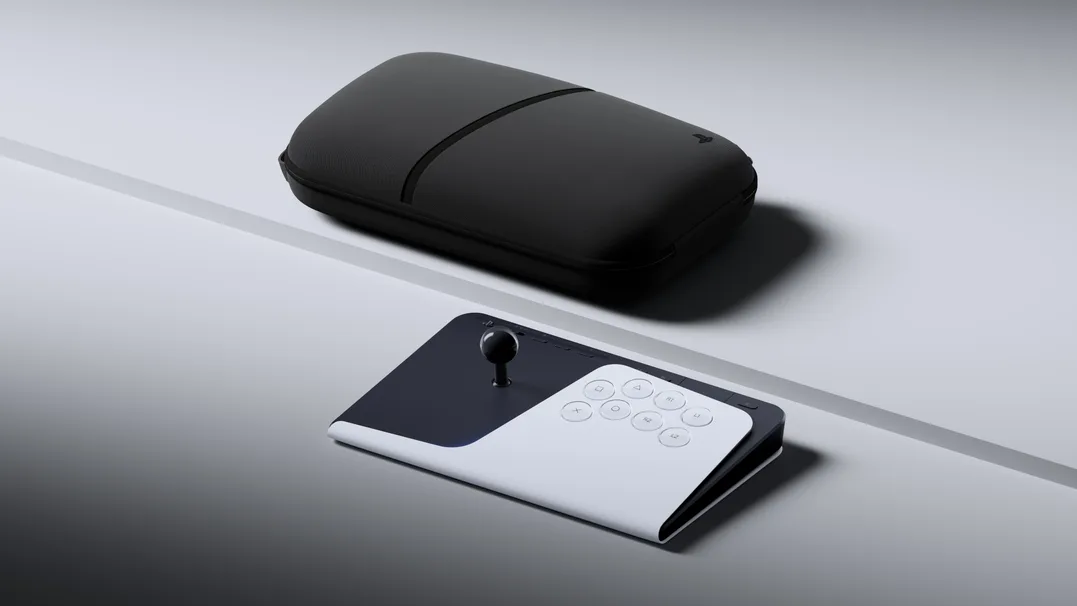
Arriving as Sony’s premier native wireless arcade controller, the FlexStrike Wireless Fight Stick ($199.99 USD) represents a major play for the competitive fighting game community (FGC) and desktop enthusiasts who demand tournament-grade components without standard desktop cable clutter.
Low-Latency Wireless Architecture
Historically, competitive fighting game players avoided wireless controllers due to the threat of input lag. Sony bypasses this limitation by outfitting the FlexStrike with its proprietary PlayStation Link wireless protocol. This system drops wireless latency down to a staggering 4 milliseconds, matching or beating many traditional wired alternatives.
Built for the Desk
The FlexStrike features an ergonomic, low-profile chassis with a high-friction rubberized base. While perfectly comfortable on a lap, its dimensions are optimized to sit flush on a flat desktop surface without sliding during intense inputs. Out of the box, it features seamless plug-and-play compatibility with PlayStation 5 consoles, alongside native PC driver support that allows deep button-remapping and macro profile configurations via desktop software.
3. High-Fidelity Audio: Pulse Elevate Wireless Speakers
To round out the visual and tactile elements of the workspace, Sony is expanding its audio footprint with the Pulse Elevate Wireless Speakers. Rather than relying on traditional multi-channel desktop speaker arrays that require complex routing and subwoofers under the desk, these compact stereo units deliver studio-tier acoustic performance directly to your ears.
Acoustic Breakthrough: Planar Magnetic Drivers
Unlike standard cone drivers found in typical PC speakers, the Pulse Elevate units incorporate the same ultra-premium planar magnetic drivers found in Sony’s high-end elite wireless headsets. These flat diaphragms vibrate across their entire surface, resulting in near-zero distortion, lightning-fast transient response, and pristine high-frequency clarity.
Spatial Awareness Without Headset Fatigue
When positioned on a desk, the Pulse Elevate speakers work alongside PlayStation’s Tempest 3D AudioTech to project a panoramic, holographic soundstage. This allows players to pinpoint enemy footsteps or ambient cues with theater-quality spatial awareness, eliminating the physical fatigue and heat buildup of wearing an over-ear headset during marathon gaming sessions. Packaged with a modular desktop charging dock and boasting a 12-hour portable battery life, they can easily transition around the workspace or connect seamlessly across multiple devices via PlayStation Link and Bluetooth.
Technical Specifications: The Ecosystem Blueprint
To see how these individual pieces fit together into a unified workstation, review the core capabilities driving Sony’s desktop lineup:
| Peripheral | Primary Target | Key Technical Specs | Ecosystem Synergy |
| PlayStation 27″ Monitor | Dual PC/Console Display | 1440p IPS, 240Hz (PC) / 120Hz (PS5), 95% DCI-P3 | Built-in DualSense charging hook; Auto-HDR tuning for PS5. |
| FlexStrike Fight Stick | Competitive FGC | PlayStation Link Wireless (4ms latency), Sanwa-style switches | Shares PlayStation Link USB dongles; cross-platform profiles. |
| Pulse Elevate Speakers | High-Fidelity Desktop Audio | Planar Magnetic Drivers, Tempest 3D Audio, 12hr battery | Lossless audio switching between PC and console via Link. |
The Strategic Vision: Beyond the Living Room TV
Sony’s transition into desktop hardware isn’t an accident or a minor side project—it’s a calculated response to shifting industry dynamics. According to recent Sony investor updates and executive strategy briefings, the company is actively preparing for a future where the PlayStation platform is defined as an experience ecosystem rather than a single physical box under a TV.
Internal analyst projections indicate that PlayStation’s PC gaming revenue has grown into a highly lucrative contributor. With major live-service titles like Helldivers 2 launching simultaneously on PC, and blockbuster single-player games arriving on desktops after a curated console window, Sony no longer views the PC player base as a rival platform. Instead, they view the desktop as a massive storefront expansion.
By crafting a beautiful, uniform ecosystem of stark white-and-black hardware that mirrors the aesthetic language of the PS5 and PS5 Pro, Sony is solving a critical branding challenge. They are ensuring that even when a player chooses to sit at a desk, utilize a high-end custom PC rig, or run a dual-platform workstation, they are visually and tangibly immersed in the PlayStation world. The desktop revolution has arrived, and PlayStation is claiming the centerpiece of the desk.
For a closer look at the ecosystem’s flagship display, the PlayStation 27″ Gaming Monitor Design Story Video offers a detailed visual breakdown of its structural aesthetics, the mechanics of the integrated controller charging hook, and how it seamlessly fits into a premium desktop layout.