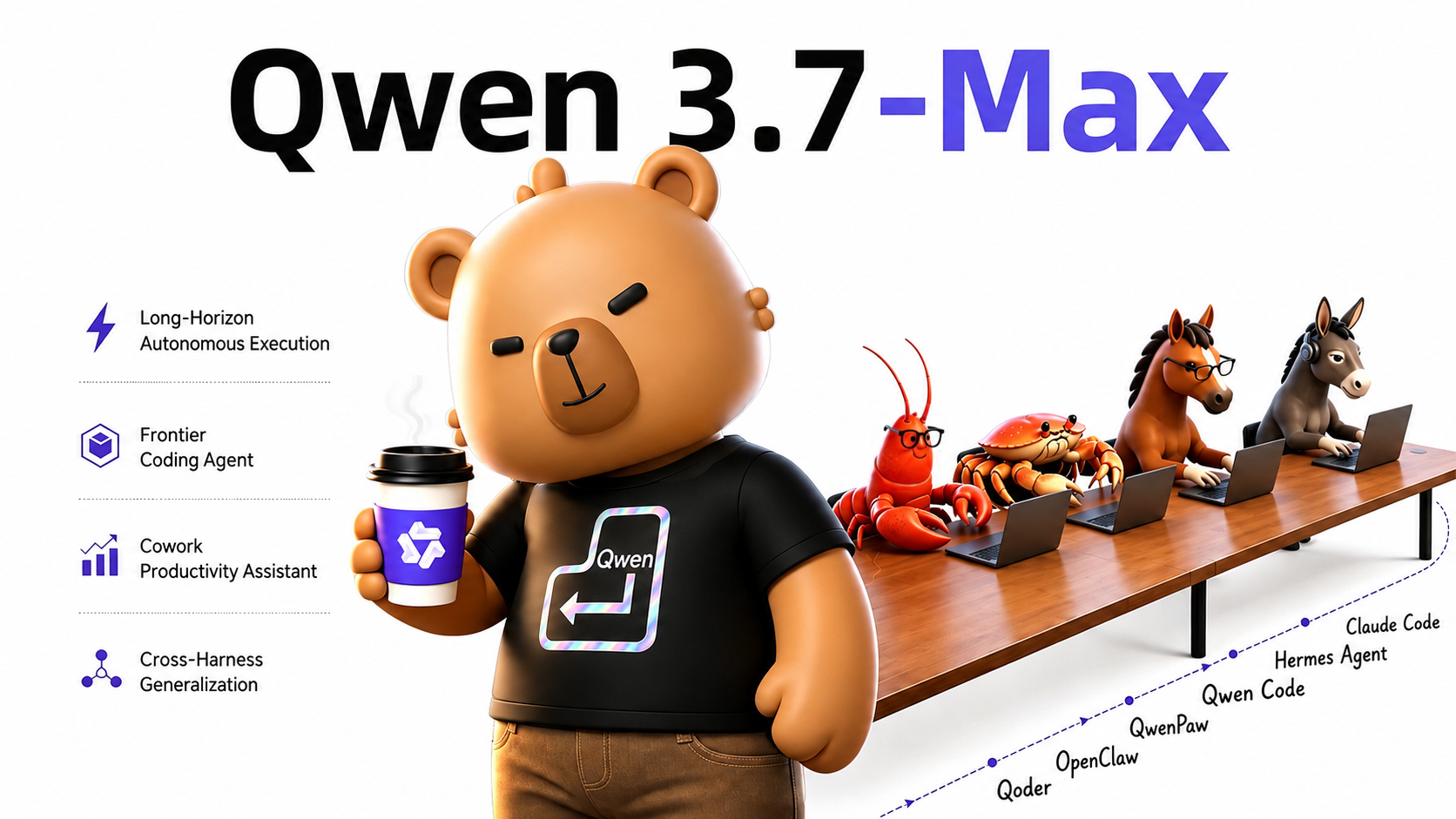
Qwen 3.7-Max Launched: Alibaba’s New Model Claims Global Dominance
Qwen 3.7 Max is Alibaba's flagship AI model featuring a 1-million token context window, elite mathematical reasoning, and advanced autonomous agency.

The global artificial intelligence race just encountered a major tectonic shift. For the past several quarters, the absolute peak of LLM intelligence benchmarks was considered an exclusive playground for Silicon Valley giants like OpenAI, Google, and Anthropic. However, the landscape has officially been broken wide open. At the recent Apsara Cloud Summit in Hangzhou, Chinese tech giant Alibaba officially dropped Qwen 3.7-Max-Preview, a massive, closed-weights flagship model that is already shaking up the global leaderboards.
This is not just another minor open-weights iteration or an incremental update. Qwen 3.7-Max is built from the ground up as a high-density, multi-step logical reasoning engine designed specifically to challenge Western dominance in complex coding pipelines, extreme mathematical deductions, and long-horizon autonomous agency.
With an extended-thinking mode and unparalleled token processing economics, this release is forcing every major developer to completely rethink their enterprise infrastructure. This comprehensive breakdown analyzes the core architecture, benchmark metrics, real-world tool execution data, and global implications of Alibaba’s massive breaking release.
Technical Specifications: The Qwen 3.7 Core
To understand how this new model stands toe-to-toe with the world’s most advanced systems, let’s look directly at its verified launch parameters:
- Model Variation: Qwen 3.7-Max-Preview (Flagship Closed-Weights Architecture)
- Primary Developer: Alibaba Cloud Intelligence Group
- Context Capacity: 1,000,000 Tokens (Fully integrated with Extended-Thinking mode)
- LMSYS Arena Ranking: #13 Overall Worldwide (#7 for Complex Mathematics / #10 for Coding)
- Artificial Analysis Score: 56.6 (The highest-indexed model out of the Eastern tech sector)
- Launch Interface Pricing: $2.50 Input / $7.50 Output (Per 1 Million Tokens via OpenRouter)
- Primary Operational Moat: 35-Hour unsupervised autonomous agent tool-chaining
1. Context Velocity: The 1-Million Token Extended-Thinking Architecture
One of the most immediate engineering highlights of Qwen 3.7-Max is its massive 1-million token context window. While processing long strings of documents is common for modern LLMs, long context windows frequently suffer from severe data degradation—often referred to by data scientists as the “needle in a haystack” problem, where a model loses track of information buried in the middle of a massive file.
To prevent this recall loss, Alibaba implemented an advanced Extended-Thinking Mode. When handed a highly complex task—such as auditing an entire enterprise software repository or analyzing hundreds of pages of legal financial cross-examinations—the model does not just spit out the first statistical response it generates.
Instead, it spins up internal multi-turn logical verification loops, actively checking its own intermediate steps and mathematical calculations before returning the final text to the user. This architectural choice enables the model to maintain perfect data integrity across its entire 1M context space, changing how teams approach deep codebase analysis.
2. Breaking the Benchmarks: Global Leaderboard Analytics
The launch data confirms that Qwen 3.7-Max isn’t just riding on marketing hype. It has officially landed on the global LMSYS Chatbot Arena leaderboard with an exceptional Elo rating of 1,475, placing it at #13 in the world across all tested language models.
When evaluating specialized academic and technical tasks, the model’s performance becomes even more impressive:
| Evaluation Metric Hub | Specific Track Area | Global Ranking Status | Artificial Analysis Rating |
| LMSYS Text Arena | General Human Preference | #13 Globally | Elo Rating: 1,475 |
| Advanced Mathematics | Discrete Logic & Calculation | #7 Globally | Top Tier Eastern Score |
| SWE-Bench Equivalent | Code Synthesis & Compilation | #10 Globally | Advanced Syntax Retention |
| Overall Indexing | AI Infrastructure Rating | Highest Ranked Chinese Model | Index Score: 56.6 |
On the Artificial Analysis Intelligence Index, Qwen 3.7-Max secured a definitive 56.6 points, officially making it the highest-performing model ever produced by a Chinese lab. Its unmatched #7 position in mathematics is a direct result of the Extended-Thinking mode, allowing it to easily solve dense algebraic number theories that typically cause standard, fast-reply chatbots to hallucinate.
3. Autonomous Agency: The 35-Hour Tool-Chaining Milestone
While benchmark numbers look great on paper, the true test of a next-generation AI model lies in its ability to execute real-world tasks unassisted. During the live keynote at the Apsara Summit, Alibaba demoed Qwen 3.7-Max powering an autonomous software engineering agent through a brutal stress test.
The model was given a long-term data engineering objective and left to run completely unsupervised. It managed a continuous 35-hour autonomous runtime, actively chaining together over 1,000 consecutive tool calls.
Throughout this grueling window, the model independently spun up shell environments, queried external SQL databases, debugged syntax issues, and verified web API calls. Crucially, the system exhibited zero task drift—meaning it never lost sight of its original objective or got stuck in an infinite error loop. This milestone moves AI firmly past the phase of basic text generation and directly into the realm of fully capable digital workers.
4. The Economic Disruption: Aggressive Token Value
Building an immensely capable model is meaningless if the operational compute costs are too expensive for production environments. Alibaba is positioning Qwen 3.7-Max as a highly disruptive option by launching it on OpenRouter at $2.50 per million input tokens and $7.50 per million output tokens.
By keeping costs significantly lower than legacy Western frontier models, Alibaba is forcing a massive price war across the entire industry. For businesses deploying large-scale agentic networks that process millions of background tokens an hour, switching to the Qwen ecosystem represents an immediate and massive drop in operational overhead.
The Forantech Final Takeaway: A Brand New AI Playing Field
The launch of Qwen 3.7-Max makes one thing completely clear: the era of absolute Western dominance in frontier AI models is officially over. By pairing top-tier reasoning capabilities with a massive 1-million token context window, an unprecendented 35-hour autonomous runtime, and highly disruptive token pricing, Alibaba has delivered a world-class platform built for heavy, production-grade applications.
As this model moves out of preview and into wide enterprise deployment, it is going to be incredibly exciting to watch how fast developers leverage its extreme multi-step tool processing to automate complex, long-horizon software projects.
Key Pros & Cons
- Pros: Top-tier mathematical reasoning and advanced code synthesis; flawless data retention across a massive 1-million token context window; highly disruptive, developer-friendly pricing structure.
- Cons: The flagship Max tier is currently a closed-weights preview model; integrating extended-thinking workflows requires careful latency planning for real-time user applications.
What’s your take?
Are you planning to test Qwen 3.7-Max via OpenRouter for your development projects? Do you think its 35-hour autonomous agent runtime will fundamentally change backend development workflows? Let us know your thoughts in the comment section below!