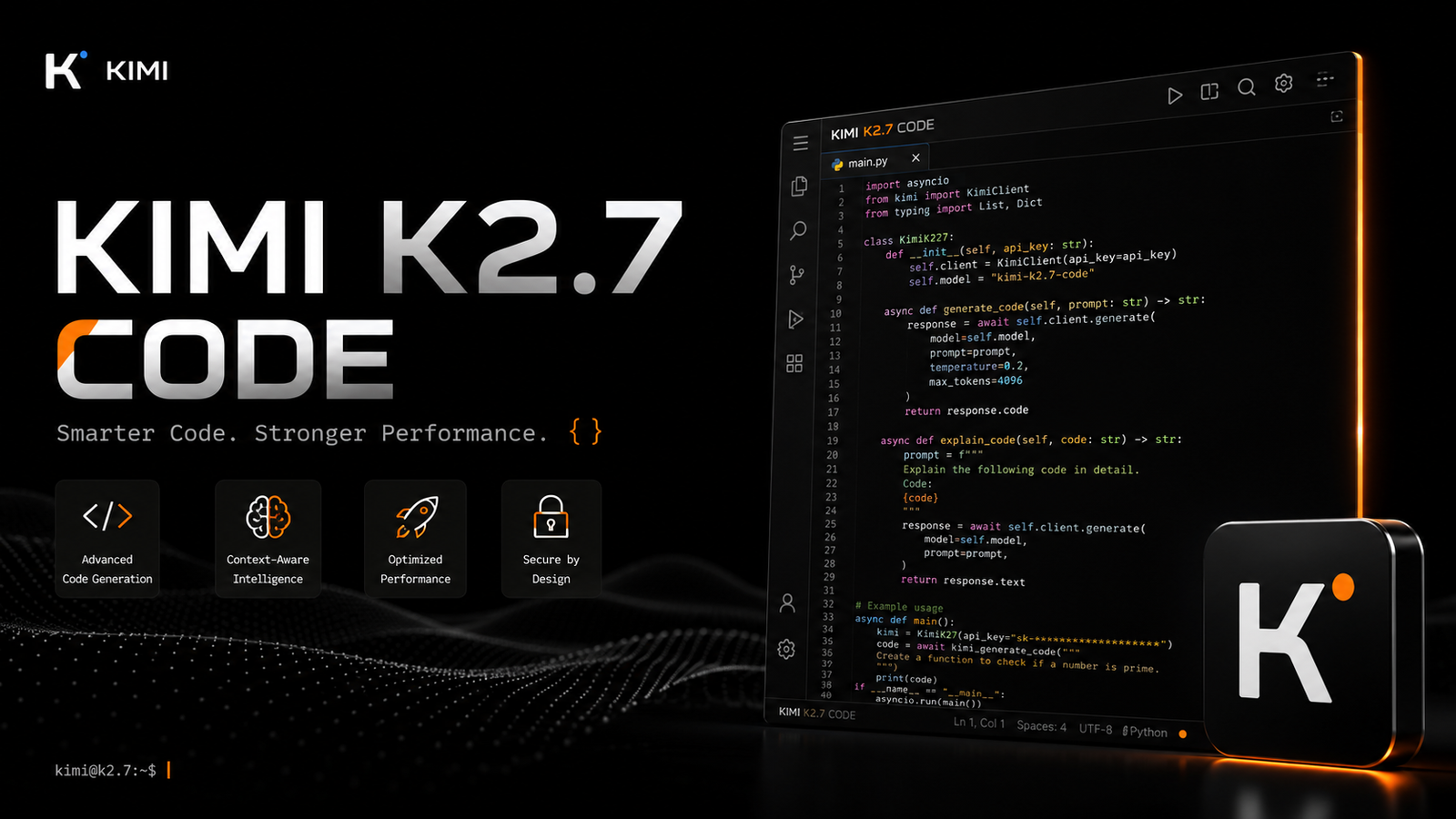
Meet Kimi K2.7 Code: Moonshot AI’s Agentic Programming Powerhouse
Moonshot AI’s Kimi K2.7 Code is an open-weight, 1-trillion parameter MoE model optimizing long-horizon programming with 30% fewer thinking tokens.

If you have been keeping an eye on the open-source AI landscape lately, things just got incredibly interesting. Moonshot AI has dropped Kimi K2.7 Code, a massive 1-trillion-parameter Mixture-of-Experts (MoE) model engineered specifically for autonomous software engineering and complex, long-horizon developer workflows.
This isn’t just another general-purpose LLM trying its hand at writing basic Python functions. Kimi K2.7 Code is built for the gritty reality of modern software development: jumping into huge, multi-file codebases, diagnosing breaking bugs, executing repo-scale refactors, and interacting seamlessly with external developer tools.
Let’s pull back the curtain on this release, look closely at the architecture, dive into the actual benchmark data, and map out what it takes to deploy this behemoth locally or via API.
1. Under the Hood: The 1-Trillion-Parameter Architecture
At a high level, Kimi K2.7 Code utilizes a massive Mixture-of-Experts (MoE) architecture. While the absolute parameter count scales up to an eye-watering 1 Trillion, it remains surprisingly computationally efficient by activating just 32 Billion parameters per token at any given moment.
The model relies heavily on architectural optimizations popularized by state-of-the-art open models:
- Multi-head Latent Attention (MLA): This mechanism keeps the Key-Value (KV) cache incredibly compressed. For developer workflows where you are feeding entire code repositories or long logs into a 256K context window, an efficient KV cache is the difference between smooth streaming and running out of hardware memory instantly.
- SwiGLU Activation & 61 Layer Depth: The deeper architecture (consisting of 61 layers, including 1 dense layer and 384 specialized routing experts) provides the dense reasoning canvas needed to plan architectural shifts in code without losing track of instructions halfway through.
- Integrated Vision via MoonViT: It isn’t just restricted to text. It includes a 400M-parameter vision encoder, allowing developers to pass UI screenshots, frontend layouts, or chart renders directly into the context alongside the source code.
2. Hard Data: How It Matches Up Against the Giants
Moonshot AI pitted Kimi K2.7 Code directly against its older sibling (K2.6), alongside proprietary heavyweights like GPT-5.5 and Claude Opus 4.8. The evaluation targets two distinct arenas: pure code generation and agentic tool-use execution.
Coding Benchmarks
The coding evaluations move past simple, single-prompt script generation to test deep structural logic.
| Benchmark | Kimi K2.6 | Kimi K2.7 Code | GPT-5.5 | Claude Opus 4.8 |
| Kimi Code Bench v2 | 50.9 | 62.0 | 69.0 | 67.4 |
| Program Bench | 48.3 | 53.6 | 69.1 | 63.8 |
| MLS Bench Lite | 26.7 | 35.1 | 35.5 | 42.8 |
What the benchmarks mean: Program Bench is an intense evaluation where an agent must recreate a program’s behavior entirely from scratch using nothing but a compiled binary and its documentation, tested against a massive fuzz-testing suite. In MLS Bench Lite (multi-language coding), K2.7 Code essentially erases the open-weight penalty, breathing right down the neck of GPT-5.5.
Agentic & Tool-Use Benchmarks
Because real-world engineering requires models to act as autonomous agents—discovering, selecting, and chaining tools together—the model was heavily evaluated on the Model Context Protocol (MCP) ecosystem.
| Benchmark | Kimi K2.6 | Kimi K2.7 Code | GPT-5.5 | Claude Opus 4.8 |
| Kimi Claw 24/7 Bench | 42.9 | 46.9 | 52.8 | 50.4 |
| MCP Atlas | 69.4 | 76.0 | 79.4 | 81.3 |
| MCP Mark Verified | 72.8 | 81.1 | 92.9 | 76.4 |
On the human-verified MCP Mark Verified suite—which tests an AI’s capacity to correctly invoke tools across live environments like GitHub, Postgres, and Playwright—Kimi K2.7 Code scores a brilliant 81.1, comfortably overtaking Claude Opus 4.8.
3. Curing the “Overthinking” Problem: Reasoning Efficiency
One of the most valuable upgrades in K2.7 Code isn’t a higher score—it’s a lower bill.
First-generation reasoning models have a bad habit of overthinking simple tasks. They might burn through thousands of reasoning tokens over-analyzing a basic syntax error. Moonshot optimized the internal verification loops in K2.7 Code, resulting in a 30% reduction in thinking-token usage compared to K2.6 while achieving vastly superior accuracy.
Because reasoning tokens are billed at full output rates on most API platforms, cutting 30% of that hidden overhead drastically lowers the runtime cost of running long, multi-turn developer agent loops.
4. How to Use and Deploy Kimi K2.7 Code
Depending on your security requirements, budget, and infrastructure, you can tap into K2.7 Code through two distinct avenues: managed APIs or running open-weight clusters locally.
Option A: The Cloud API Path
If you want to plug the model straight into an existing IDE extension, terminal CLI, or enterprise pipeline, the managed API is standard, OpenAI-compatible, and highly cost-efficient. It is available globally via providers like the Kimi Open Platform and Microsoft Foundry.
- Input Cost (Cache Miss): $0.95 per 1M tokens
- Input Cost (Cache Hit): $0.19 per 1M tokens (Crucial for long codebases; keeping your repo cached cuts input costs by 80%)
- Output Cost (Includes Reasoning): $4.00 per 1M tokens
Critical API Configuration Constraints
The model operates with mandatory thinking mode. You cannot bypass the reasoning phase. Furthermore, its hyper-parameters are structurally locked to safeguard the reasoning pathways; changing them will throw an API error:
Python
Option B: Local Heavy-Metal Deployment
Because the weights are open under a Modified MIT License (allowing commercial use with attribution), you can fully self-host this model. However, hosting a 1-trillion-parameter model locally is an immense hardware challenge.
To run the model on a single machine or workstation, you must leverage quantization frameworks like Unsloth Dynamic Quants or llama.cpp:
- The Lossless Standard (Q8 / INT4-Native): Because Moonshot naturally uses INT4 for its MoE weights and BF16 for its dense layers, the GGUF profile is completely lossless. It requires roughly 605 GB of unified memory or VRAM. The ideal hardware setup here is a single high-tier server node housing 8x H100 (80GB) GPUs running with high-speed NVLink interconnects.
- The Workstation Compromise (Dynamic Q2): By utilizing specialized quantization adjustments (like custom bijection patching on the MoE layers to bring absolute math error down to near zero), teams can run the compressed profile. This brings the storage and memory footprint down to 325–350 GB. It allows you to run a 1T-parameter model locally on a top-tier Mac Studio (M3 Ultra with 512GB Unified Memory) or a tightly integrated 4-card workstation cluster.
If you have the hardware infrastructure to back it up, or if you can leverage aggressive context caching over their API, Kimi K2.7 Code stands out as an incredibly powerful, deeply analytical asset for engineering teams looking to build robust, autonomous developer workflows.