Huawei AI-ON: The New Backbone for 10 Gbps AI Traffic
Huawei launches ten AI-Optical Network products at MWC Shanghai, establishing ultra-high-speed 10 Gbps target networks optimized for token monetization.

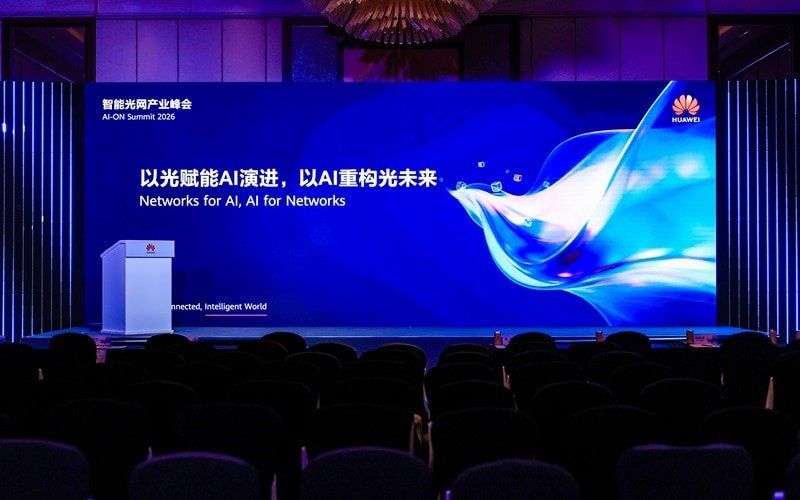
The infrastructural race to support massive artificial intelligence computing demands has moved directly into the fiber-optic pipeline. Today, June 25, 2026, at the MWC Shanghai AI-ON Summit, Huawei officially unveiled ten innovative AI-Optical Network (AI-ON) products and solutions.
This hardware suite is engineered to move carrier architectures past standard data routing, transitioning global operators into an AI-centric network paradigm designed to handle the massive traffic overhead of live large language models and autonomous agents.
Technical Specifications: Huawei AI-ON Product Matrix
To fully map out how these newly announced hardware arrays optimize token processing and computing access across metropolitan centers, look at the verified deployment parameters:
| Engineering Layer | Confirmed Infrastructure Selection | Real-World Operational Status |
| Primary Project Target | Huawei AI-Optical Network (AI-ON) Solution Suite | Officially launched; enter large-scale commercial deployment phases |
| Broadband Threshold | 50G PON High-Density Service Boards | Upgraded to support tri-band Wi-Fi 7 (3+3+3 architecture) |
| Latency Target | 1-Millisecond Dedicated Computing Networks | Achieved via Mini OXC and end-to-end fgOTN pipelines |
| Consumer Hardware | AI-FTTR (Fiber-to-the-Room) Home Hub and Smart Box | Deploys localized AI traffic identification inside residential properties |
| Security Layer | Optical Transport Network & QKD Integration | Quantum Key Distribution protocols merged into the physical fiber layer |
1. The 1-Millisecond Rule: Mini OXC and fgOTN Integration
For high-concurrency AI applications like real-time spatial rendering or industrial robotic control, traditional data center latency creates severe processing bottlenecks. Huawei’s updated architecture fixes this by deploying a specialized Mini OXC (Optical Cross-Connect) infrastructure.
By combining these compact optical switches with fine-grain transmission pipelines, the network establishes dedicated 1-millisecond speed corridors connecting end-users directly to regional data center clusters. This technical choice removes intermediate cloud-routing steps, ensuring that complex AI reasoning loops execute with near-zero network delay.
2. Token Monetization: Transitioning Beyond Simple Bandwidth
The true commercial driver behind the AI-ON rollout is a fundamental shift in how telecommunication providers generate revenue. As multimodal AI agents dominate web traffic, traditional data packages are proving inefficient.
- Traffic Recognition: The built-in AI-FTTR home hubs use edge micro-models to instantly separate standard video streams from generative token queries.
- Precision Scheduling: The core gateway allocates bandwidth dynamically, prioritizing high-value AI processing tasks over low-priority background downloads.
- Value-Driven Operations: Allows operators to establish pricing tiers based on token delivery speeds rather than raw gigabyte data volume.
The Optical Token Law: The sustainability of future AI models depends on the underlying glass network. If a fiber-optic architecture cannot distinguish a raw data packet from an active agent logic request, it cannot optimize the real-time resource distribution needed for token-based software economies.
3. 50G PON Hardware Scaling and Wi-Fi 7 Integration
To prevent high-density urban areas from bottlenecking the network, Huawei has launched the industry’s first commercial high-density 50G PON (Passive Optical Network) service board.
This enterprise-grade hardware upgrades traditional infrastructure to support an aggressive 10 Gbps data delivery rate straight to localized neighborhoods. When paired with the new tri-band Wi-Fi 7 capabilities built directly into the consumer routers, the hardware guarantees that high-speed local wireless connections can successfully match the blazing-fast speeds of the incoming core optical lines.
The Verdict: The Fiber Foundation for the AI Era
The deployment of Huawei’s AI-ON framework marks a major turning point for the global telecommunications supply chain. While it requires network operators to completely re-evaluate their hardware investments, it provides the mandatory structural bandwidth needed to run next-generation consumer and industrial AI tools.
Pros
- Ultra-Low Latency: The 1ms core network removes processing delays for real-time edge AI workflows.
- Future-Proofed Bandwidth: High-density 50G PON boards confidently handle massive multi-user data loads.
Cons
- High Deployment Friction: Swapping out legacy switching gear for advanced Mini OXC nodes demands significant upfront infrastructure capital from global networks.
What do you think?
Do you think operators shifting toward a “token monetization” model will lead to fairer pricing for AI power users, or do you worry that separating standard data from AI processing will create unnecessary subscription fragmentation? Let us know your thoughts in the comments below!
For a closer look at how customized database structures, localized theme configurations, and automated backend routing scripts are deployed to support high-traffic media websites, check out the development documentation on the ForanTech Tech Portal. This analysis resource tracks all responsive interface setups and modern optimization techniques transforming the digital space.
To review the comprehensive hardware specs, structural network diagrams, and executive keynote transcripts released live from the showroom floors, read through the official Huawei MWC Shanghai Media Center Feed. This technical archive lists every precise variable change guiding the new all-optical target network era.