ASUS ProArt P16 Laptop: The Big Boy You Need in 2026
ASUS's newly unveiled ProArt P16 creator laptop introduces a 1-petaflop computing envelope via NVIDIA's unified RTX Spark superchip architecture.

The modern mobile computing industry has spent the last few product cycles trapped in a deeply exhausting, wildly predictable cycle of corporate repetition. Dominant platform holders and mainstream manufacturing labs have grown entirely comfortable rolling out minor physical chassis adjustments, incremental internal component revisions, or basic software variations that refuse to alter the core structural experience of consumer hardware. Technology bloggers, software developers, and daily creative professionals have grown completely burned out by this passive approach: you are constantly forced to absorb defensive public relations marketing while enduring high entry price points, rising component manufacturing costs, and stagnant design logic that fails to capture the raw creative magic of early mobile breakthroughs.
On June 11, 2026, ASUS completely shattered that narrative of quiet corporate iteration.
While mass-market focus was anchored on iterative mid-range hardware refreshes, ASUS used its flagship platform to deploy a radical, uncompromised structural shift in computing architecture.
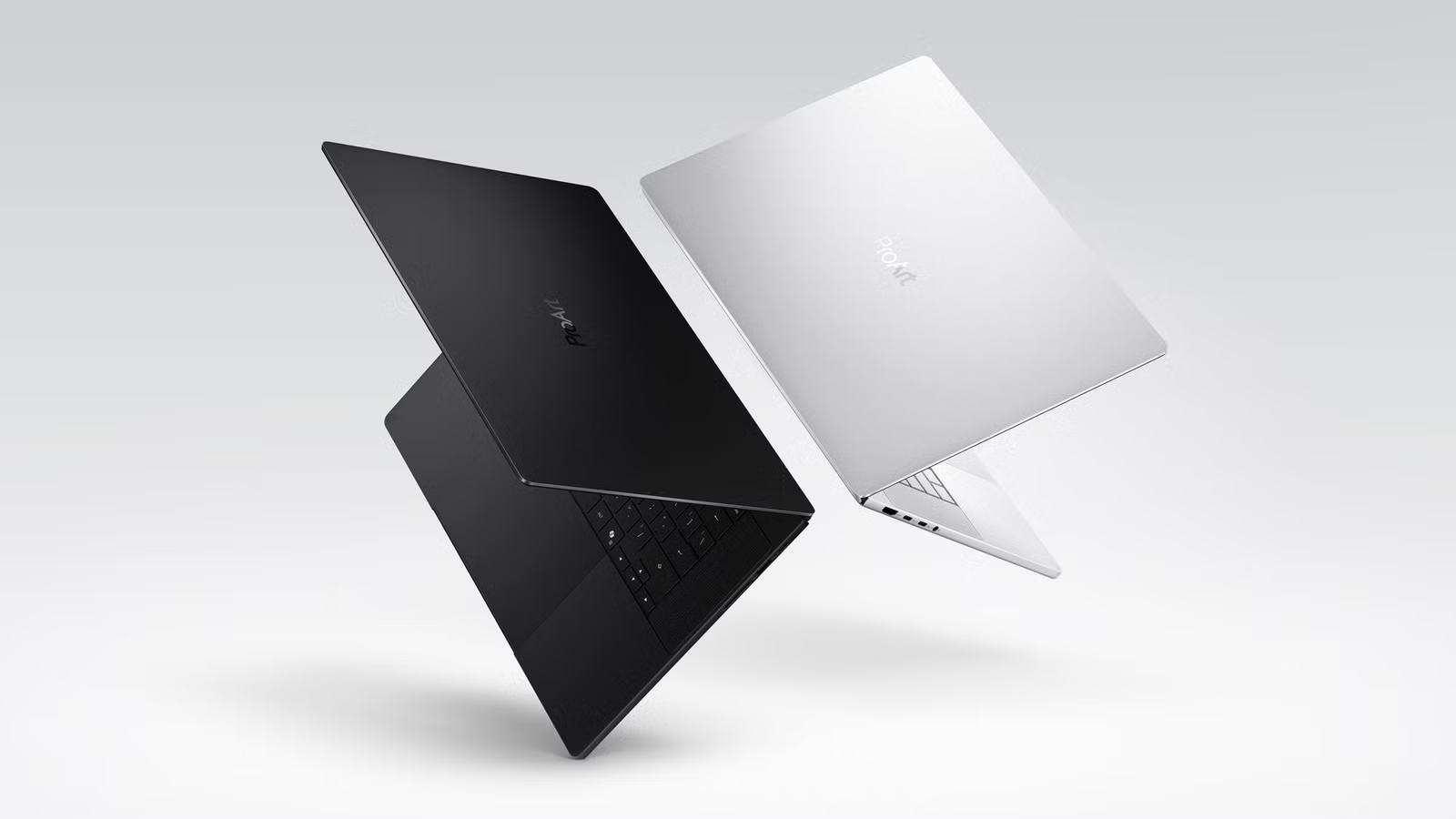
The company officially launched the next-generation ASUS ProArt P16 creator workstation. Far from a standard seasonal update, this machine represents the world’s first commercial implementation of the highly anticipated NVIDIA RTX Spark™ platform.
By ditching traditional split-component system layouts in favor of an integrated unified silicon footprint, the new ProArt P16 jumps straight past legacy hardware bottlenecks to unlock an unbelievable 1 petaflop of local artificial intelligence performance. Let’s look straight beneath the hood at the factory-verified telemetry parameters, real-world development advantages, and structural hardware transformations driving this historic mobile workstation evolution.
Technical Specifications: The New ProArt P16 Architectural Grid
To truly appreciate how heavily ASUS and NVIDIA’s engineering teams have re-engineered their processing pipelines, local memory execution paths, and thermal cooling matrices to support massive local developer models, let’s look at the verified launch parameters:
| System Layer | Verified Architecture Component | Real-World Operational Impact |
| Core Compute | NVIDIA RTX Spark™ Unified Superchip Architecture | Delivers a colossal 1-petaflop computing envelope for local agency execution |
| Processor Spine | 20-Core ARM-Based NVIDIA Grace™ CPU Node | Handles dense multi-threaded compilation trees with minimal passive power draw |
| Graphics Core | Blackwell-Architecture NVIDIA RTX GPU (6,144 CUDA Cores) | Renders ultra-large 90GB+ 3D assets and 12K video files completely on-the-go |
| Interconnect | Proprietary NVIDIA NVLink®-C2C Signaling Hub | Sustains a massive 900 GB/s bidirectional bandwidth stream between CPU and GPU |
| Unified Memory | 128GB High-Speed Low-Power Subsystem Array | Allows local execution of massive 120-billion parameter Large Language Models |
| Visual Interface | 16-inch 4K High-Density Lumina OLED Touch Panel | Pushes pristine color-accurate spaces with full stylus response layers |
1. The NVIDIA RTX Spark Integration: Unmasking the 1-Petaflop Superchip
Historically, when a primary hardware manufacturer prepares to deploy a professional creator workstation, they rely on a highly calculated corporate template. They match a traditional x86 processor from one silicon vendor with a separate discrete graphics chip from another, linking them across a restrictive physical PCIe motherboard lane. This legacy design creates significant internal data travel delay, forces components to battle for shared thermal limits, and causes severe battery drain that leaves professionals tethered to a wall outlet during heavy video rendering or data compiling.
The arrival of the ASUS ProArt P16 completely breaks this historical pattern by deploying the unified RTX Spark platform.
Developed via a strategic hardware collaboration with MediaTek to maximize architectural power efficiency, the RTX Spark superchip merges a 20-core ARM-based Grace CPU directly with a massive Blackwell-generation RTX graphics core on a single, highly dense silicon package. By removing the traditional physical motherboard distances that bottleneck standard laptops, the system utilizes an ultra-fast NVLink-C2C connection to push data between processing elements at an incredible 900 GB/s. This provides an unprecedented 1-petaflop computing envelope, transforming the laptop from a simple digital tool into a hyper-responsive, local creative teammate.
2. Local Model Freedom: Harnessing the 128GB Unified Memory Buffer
Beyond the raw processing cycles delivered by the Blackwell architecture, the June 11 launch exposes an incredibly advanced memory configuration that directly fixes the greatest hardware bottleneck facing modern developers and data engineers. For years, mobile creators have been trapped by restrictive memory ceilings: if you need to run dense local language models, execute complex data training scripts, or render massive, multi-layered visual sets, standard laptops run out of memory, causing systems to crash or freeze.
The ProArt P16 addresses this critical barrier by offering a massive 128GB Unified Memory Subsystem.
Because the memory pool is completely unified across the entire superchip, both the 20-core Grace CPU and the Blackwell GPU can access the entire 128GB buffer instantly with zero data duplication lag. This incredible hardware capacity allows software engineers and researchers to run 120-billion parameter Large Language Models (LLMs) locally on their machine with up to a 1-million token context window. Sensitive source code, private dataset arrays, and confidential intellectual assets no longer need to be transmitted to external cloud servers, guaranteeing absolute data privacy and allowing for deep, offline structural work anywhere in the world.
3. Rearchitected Creative Tools: Native Optimization at the Silicon Level
The professional software ecosystem has spent the last several product cycles hitting a clear optimization wall regarding application execution and hardware translation. When creative software utilities are built to run on generic, fragmented hardware frameworks, they fail to take full advantage of specialized internal accelerators, leaving creative pros to endure slow rendering times and laggy timelines.
The deployment of the ProArt P16 directly resolves this operational gap through deep industry software integration.
Concurrently with the hardware release, major software houses like Adobe have rearchitected core industry applications, including Photoshop and Premiere Pro, from the ground up specifically for the RTX Spark architecture. By leveraging native CUDA pipelines and fifth-generation Tensor Cores featuring ultra-dense FP4 precision formats, these updated tools deliver a massive 2x increase in real-time editing and effect processing performance. Video editors can effortlessly scrub through native 12K 4:2:2 video streams and apply intricate multi-track color grading curves without rendering proxies or experiencing dropped frames.
4. Professional Mobility: Lumina OLED Excellence and 25-Hour Stamina
For digital artists, frontend web developers, and mobile operators who evaluate a machine based on its daily physical usability, the most vital element of this launch is how cleanly ASUS wrapped this extreme power into a highly portable form factor. High-performance workstations traditionally require thick, bulky chassis designs and massive power bricks that make mobile work an exhausting, uncomfortable experience.
The ProArt P16 masterfully bypasses these physical limitations by utilizing a premium, thin-profile aluminum chassis.
The device features a spectacular 16-inch 4K Lumina OLED Touch Panel that provides perfect color accuracy, an infinite contrast ratio, and full stylus input support for intricate design work. Thanks to the extreme thermal efficiency of the ARM-based Grace processor and platform-level power optimizations embedded within Windows 11, the laptop achieves unmatched operational efficiency. When handling standard daily productivity tasks, data logging, or frontend editing, the system can deliver up to 25 hours of continuous battery life, allowing professionals to confidently leave their charging cables behind for an entire weekend of mobile deployment.
The Verdict: ASUS Reshapes the Horizon of Professional Mobile Computing
The official rollout of the ASUS ProArt P16 Creator Workstation represents an uncompromised, incredibly calculated tactical milestone for the hardware industry. By matching NVIDIA’s unified 1-petaflop RTX Spark superchip with a massive 128GB unified memory matrix, native Adobe optimization layers, a gorgeous 4K Lumina OLED panel, and exceptional real-world battery endurance, ASUS has established an outstanding benchmark that completely redefines the modern high-end portable computing landscape.
Pros
- Unprecedented Computing Density: The unified RTX Spark superchip delivers an incredible 1-petaflop AI processing envelope right on your desk.
- Colossal Unified Memory: A 128GB shared pool enables seamless execution of massive 120B-parameter models completely offline.
- Native Software Overhauls: Rearchitected Adobe tools leverage custom Tensor pipelines to double real-time creation performance.
- Incredible Mobility Footprint: The ultra-efficient ARM architecture unlocks up to 25 hours of battery life inside a sleek chassis.
Cons
- Elite Enterprise Pricing: Given the cutting-edge nature of the superchip architecture, this machine demands a massive financial premium.
- ARM Driver Ecosystem: While standard creative applications run flawlessly, highly specialized legacy development plugins may require native updates.
To evaluate additional verified benchmarking data, architectural component layouts, and real-time mobile hardware tracking charts surrounding this historic launch, you can head directly to the comprehensive Notebookcheck Industry Portal to analyze exactly how this global race for workstation dominance is taking shape!
What do you think?
Does the arrival of the ASUS ProArt P16 and its unified 1-petaflop NVIDIA RTX Spark superchip make you incredibly excited to run massive AI models and heavy video timelines completely locally, or do you feel that traditional split-component x86 laptops still hold the advantage for your specific coding workflow? Let us know your thoughts in the comment section below!