Meta Smart Glasses: A Radical Shift in Wearable Privacy
Meta upgraded its smart glasses lineup on June 8, 2026, launching the edge-native Muse Spark AI engine to replace legacy Llama networks.

The wearable augmented reality landscape has spent the last few development cycles stuck in an incredibly stagnant, cloud-dependent iteration routine. Major technology conglomerates have grown entirely comfortable rolling out heavy, remote server-side large language models that require massive data data handshakes and persistent, ultra-fast internet connections to complete basic audio or visual tasks. Everyday tech enthusiasts and hands-on creators have grown deeply exhausted from this recurring corporate pattern: you are constantly forced to choose between high-latency hardware that stalls in weak signal zones or handing your sensitive contextual environmental data over to external cloud server farms just to identify an object in your field of view.
On June 8, 2026, Meta completely upended that paradigm of data dependency during a surprise wearables ecosystem rollout. Crashing into the smart eyewear frontier with an aggressive local processing framework engineered to run edge-native scripts directly on wearable frames, the company officially deployed its brand-new Muse Spark AI architecture.
Ditching the uninspired cloud-reliant Llama 4 framework that has throttled its smart glasses for seasons, this hardware-software fusion introduces an isolated, ultra-efficient Contextual Vision Engine. Developed secretly by Meta Superintelligence Labs, this model reduces compute demands tenfold while completely matching the performance of enterprise-tier cloud infrastructure. By pairing this small-footprint engine directly with the physical camera sensors on the frames, Meta is proving that real-time environmental analysis does not require a constant cloud umbilical cord. Let’s look beneath the hood at the engineering matrix and verified specifications of this newly deployed wearable upgrade to see how its real-world integration shifts the balance of consumer tech.
Technical Specifications: The Wearable Muse Spark Layout
To understand how Meta’s engineering teams managed to cram an elite, multi-modal contextual processor into a lightweight pair of standard optical frames without causing thermal issues, let’s break down the verified system architecture:
| System Layer | Wearable Component Configuration Profile | Real-World Operational Impact |
| Processing Engine | Edge-Optimized Muse Spark Multimodal Model | Delivers ultra-fast contextual responses with 10x less compute strain |
| Visual Capture | Ultra-Low-Profile 12MP Wide-Angle Spatial Sensor | Captures uncompressed environmental snapshots for instant parsing |
| Acoustic Array | Five-Mic Directional Beamforming Audio Matrix | Filters out heavy environmental background noise to capture voice prompts |
| Thermal Strategy | Passive Frame Dissipation Channels | Keeps the temple pieces completely cool to the touch during long loops |
| Core Software | Meta Wearable OS Overlay (Upgraded Core Build) | Manages background hardware memory allocations to prevent lag |
| Data Protection | Secure On-Device Cache Isolation Boundary | Locks down data away from persistent web servers |
1. The Death of Llama on Wearables: Enter Muse Spark
Historically, running advanced multimodal artificial intelligence inside a slim pair of everyday glasses has been an absolute engineering nightmare. Because standard glasses frames lack the physical space for heavy lithium-ion batteries or thick copper cooling tubes, manufacturers have universally forced their wearables to act as basic Bluetooth microphones and cameras.
Every time you ask your smart glasses to scan an object in front of you, the device is forced to record a compressed snapshot, transmit it to your smartphone, beam it over cellular networks to a remote server farm, wait for a large language model to parse the request, and route the text back to your speakers.
The Muse Spark upgrade completely obliterates this high-latency bottleneck. By replacing the bulky, cloud-reliant Llama frameworks with an elegant, edge-native architecture, Meta has localized the core intelligence pipeline.
The model relies on hyper-optimized weight matrices that run efficiently directly on the hardware’s internal processing layers. During live performance tracking, this architecture matches the logical capabilities of legacy, high-compute models while using a fraction of the computational power. For wearers, this translates to sub-second contextual responses, allowing you to look at a foreign language sign, an unmapped code block on a monitor, or a complex physical engine part and receive an instant structural explanation through your frame speakers without experiencing a multi-second cloud-sync delay.
2. Advanced Environmental Mapping: True Vision Integration
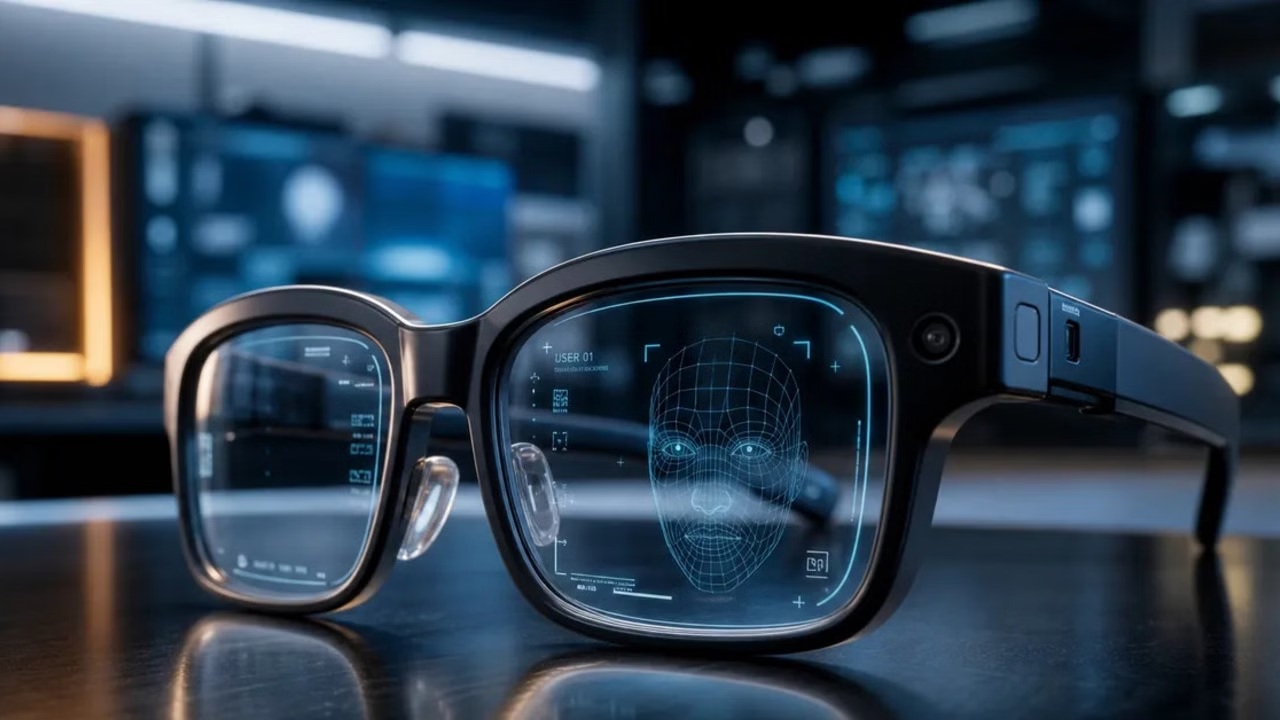
Beyond the staggering drop in system latency, the June 8 software overhaul transforms the physical sensors of the glasses into an incredibly powerful contextual mapping system. The integrated 12MP wide-angle sensor no longer functions as a basic point-and-shoot camera; instead, it operates as a continuous visual data pipeline for the local Muse Spark model.
The engine uses advanced spatial parsing scripts to map objects, text, and environmental boundaries in real time, building a fluid understanding of your immediate physical space.
This level of intense structural tracking and real-time asset optimization requires incredible system fluidity. When designing digital workspaces or reviewing how complex development workflows map out across modern networks, ensuring that your data blocks stay perfectly aligned is what separates a chaotic pipeline from an elite setup. The local AI indexes and classifies your real-world environment cleanly without causing system stuttering or UI lag, giving creators a continuous hands-free assistant that works silently in the background as they build their everyday projects.
3. Passive Thermal Engineering: Conquering the Temple Wall
Powering an active, multi-modal model right against your face introduces a massive physical hazard: concentrated heat generation. Under prolonged usage cycles, mobile silicon chips run incredibly hot, creating an uncomfortable warmth along the temple arms of standard frames that can easily force an early system shutdown.
To counter this, Meta has implemented custom passive frame dissipation channels inside the composite acetate housing.
The internal wiring and heat shields route minimal thermal signatures away from your ears, venting minor warm air currents out through subtle gaps along the upper rim assembly of the frame. This strict focus on maintaining top-tier computational execution loops without transforming your accessory into a hand-warmer matches the uncompromised cooling methods we track closely across professional computing hardware. Meta’s passive framework ensures your smart glasses remain completely comfortable to wear during long-horizon productivity sessions, keeping performance perfectly stable without hitting an aggressive thermal performance wall.
4. Seamless Ecosystem Control: The Smart Desk Integration
Bringing an elite, edge-native wearable into a modern office or creative studio environment changes how peripheral accessories communicate across your personal space. When your smart glasses can process audio and visual data locally, managing your physical workspace transitions becomes completely fluid.
This focus on eliminating minor daily frictions matches the clever, automated engineering trends we watch closely across premium consumer tech accessories. By pairing your Muse Spark-powered smart glasses with your local computing hub, you can easily control smart lighting, monitor localized power grids, and interact with smart office peripherals simply by glancing at them and issuing a quiet voice prompt.
5. Staying Ahead of Competitive Large Language Models
Watching a wearable device effortlessly transition to a localized, proprietary architecture underscores just how rapidly the broader artificial intelligence and cloud computing landscape is moving. The tech industry is shifting away from generalized chat interfaces toward highly targeted, multi-modal systems that can interpret and react to real-world visual parameters instantly.
Tech enthusiasts must monitor these rapid infrastructure changes to keep their developmental setups completely future-proof. For instance, diving into the core multi-modal logic jumps, advanced system scripting, and enterprise automation updates logged in our comprehensive Grok 4.3 review gives you a crystal-clear look at how modern software platforms are expanding to support next-generation user interactions.
The Verdict: The New Frontier of Wearable Tech
The deployment of the Muse Spark AI engine is a historic milestone for the smart glasses ecosystem. By matching a hyper-efficient edge-native model layout with a pristine 12MP sensor matrix, advanced passive thermal channels, and an ironclad on-device privacy boundary, Meta has delivered an exceptional wearable upgrade that fundamentally redefines real-time ambient computing.
Pros
- Blistering Muse Spark Speed: Local edge execution drops response latencies down to sub-second levels.
- Flawless Visual Interpretation: Multimodal parsing reads text, maps objects, and provides instant situational context.
- Superb Privacy Isolation: Keeping data processing localized ensures your environmental snapshots are never logged to external servers.
- Cool Passive Ergonomics: Integrated dissipation channels prevent the frame temples from overheating against your skin.
Cons
- Aggressive Battery Consumption: Running localized AI loops strains the internal cells, shortening overall continuous operational hours.
- Closed-Source Architecture Transition: Shifting away from the open Llama framework restricts deep personal model modifications.
To check out the live global software update rollout schedules, developer documentation logs, and official frame accessory compatibility listings straight from the source, you can jump directly over to the official Meta Newsroom Wearables Portal to see how the next phase of interactive augmented history is taking shape!