Xreal Project Aura: The AR Glasses That Could Change Everything
Xreal's Project Aura AR glasses just wowed everyone at Google I/O — and they're shipping before 2026 ends.

Smart glasses have been “the next big thing” for so long that people stopped believing it. Google Glass burned early adopters in 2013. Meta’s first-generation smart glasses were glorified earbuds with a camera. HoloLens was brilliant but cost as much as a used car and weighed like one too. Year after year, the promise of a computer on your face remained stubbornly out of reach for the average person.
2026 might be the year that changes.
At Google I/O last week, Xreal and Google pulled back the curtain on Project Aura — a pair of wired AR glasses built on Google’s Android XR platform that, by every hands-on account from journalists and analysts on the show floor, actually work. Not “impressive for a prototype” work. Not “give it two more years” work. Actually, genuinely, put-them-on-your-face-and-use-them work. The verdict from journalists who tried them: these are legit. Vr
This is the full breakdown of what Project Aura is, how it works, what it can do, and why it matters for the future of computing.
What Exactly Is Project Aura?
Before anything else, it helps to understand what Project Aura is — and what it isn’t — because the smart glasses space in 2026 has become genuinely complex.
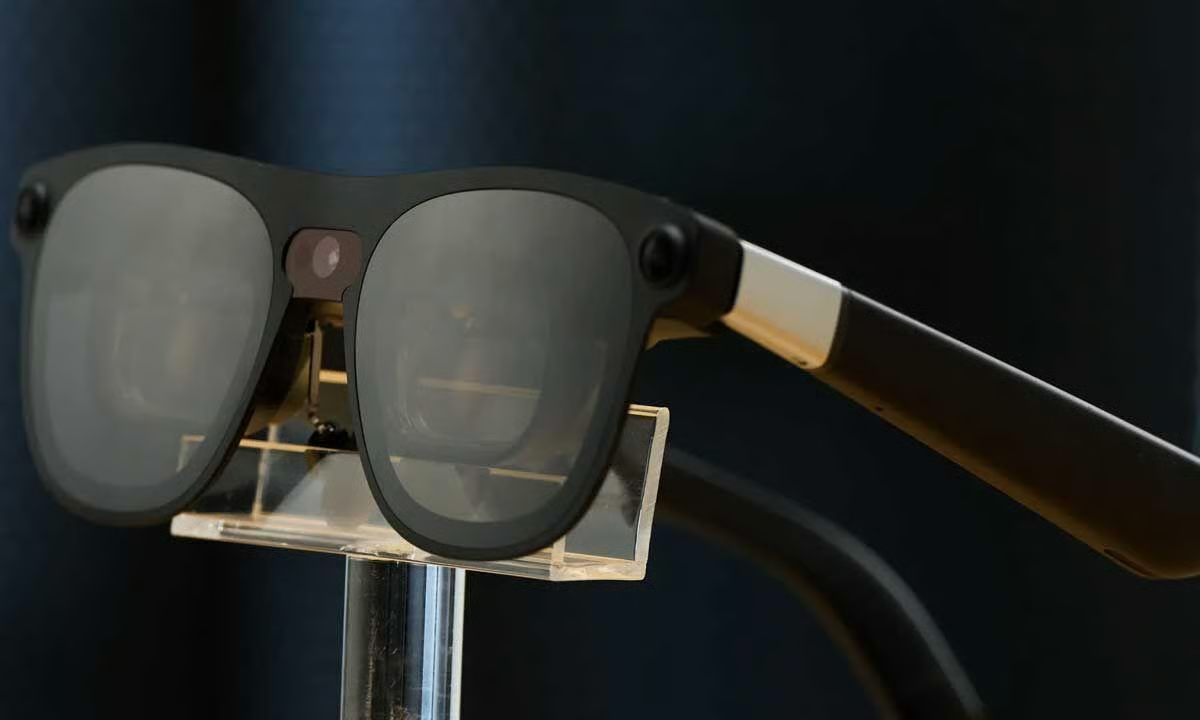
Project Aura is a visual XR device with an optical see-through display, an impressive FHD 70-degree field of view, Android XR, Gemini AI, and XREAL’s X1S spatial chip. It is the company’s first tethered XR glasses built with Google for Android XR. Ubergizmo
“Optical see-through” means you are looking at the real world through actual glass lenses — not a camera feed shown on a screen. This is a crucial distinction from headsets like the Samsung Galaxy XR or Apple Vision Pro, where your view of the world is entirely mediated by cameras and displays. With Project Aura, the real world is right in front of your eyes, and digital content is layered on top of it via OLED displays projected onto the lenses. You see both simultaneously, naturally, the way your eyes were built to work.
“Tethered” means the glasses are connected by a wire to a separate compute puck — a small device you keep in your pocket or on a desk. To keep the wearable frames exceptionally lightweight, the heavy computing hardware is handled by the split-compute external puck. This is the same approach Apple uses with the Vision Pro’s battery pack — the glasses stay light and comfortable, while the puck handles processing without overheating your face. Android Headlines
“70-degree field of view” is the spec that makes engineers sit up straight. Most consumer AR glasses on the market today sit between 45 and 52 degrees. A 70-degree field of view is one of the most generous in the category. In practical terms, virtual windows and overlays don’t feel like you’re peering through a letterbox — they feel like they actually belong in your space. Vr
The Hardware: A Three-Way Collaboration
Project Aura is the product of an unusual partnership between three companies, each contributing something critical.
The smart glasses combine a proprietary Xreal X1S spatial computing chip with a Qualcomm Snapdragon XR platform processor. Xreal brings its years of experience building lightweight AR hardware and custom silicon for spatial processing. Qualcomm provides the XR chipset that runs Android XR and handles heavy AI workloads. Google provides the operating system, the Gemini AI integration, and the app ecosystem. Android Headlines
The result is a device that, in the words of one analyst who tried it at Google I/O, is “much lighter than Galaxy XR and a stronger form factor than mixed-reality headsets for many users.” Galaxy XR launched Android XR as a full headset experience. Project Aura moves the same platform into lighter wired glasses, with the main computing hardware handled through a tethered setup rather than a full headset-style design. Ubergizmo
The frame features three cameras. One is on each side of the frames for hand tracking, and a third is in the center for snapping photos and video. There are no physical controllers — you interact using hand gestures, primarily a pinching motion that feels familiar to anyone who has used other AR setups, with the glasses able to detect hands reliably, making resizing or moving windows easy. EngadgetEngadget
One particularly clever feature: face detection that disables the lens dimming when the user is interacting with another person. It sounds like a small detail. It isn’t. One of the fundamental social problems with AR glasses has always been that wearers look disconnected — staring through you rather than at you. Auto-disabling the dimming during a conversation is exactly the kind of human-centered design decision that separates a product built for real life from one built for demo stages. Ubergizmo
What You Can Actually Do With It
At Google I/O 2026, Xreal demonstrated a range of use cases that showed what Project Aura is truly designed for.
The demos included Immersive Google Maps, large-screen and mini-screen video viewing for multitasking, YouTube 180-degree and 360-degree VR videos, 2D and 3D video playback, a WebXR 3D painting app built with Gemini, Android XR games, and a DisplayPort connection to a laptop. Ubergizmo
The Google Maps demo is particularly compelling. Spatial navigation — where turn-by-turn directions and landmarks appear as overlays on the actual street in front of you — is one of those use cases that sounds gimmicky until you try it, at which point staring at a phone screen while walking is the thing that starts to feel gimmicky.
The laptop connection mode may be the most practically interesting feature for productivity users. Project Aura was shown working via DisplayPort-in with a laptop, which includes integrated Gemini support and “autospatialization” — Xreal’s onboard process of making flatscreen games, images, and videos 3D on the fly. Plug Project Aura into your laptop and your regular 2D apps get a spatial computing layer added automatically, with Gemini available as a hands-free AI assistant throughout. Road to VR
The multitasking mode — a large main screen and a smaller secondary screen shown simultaneously — points toward a future where the glasses replace your external monitor entirely. Sit at a desk, plug into your laptop, and work inside a virtual widescreen workspace that’s visible only to you, adjustable in size and position with a hand gesture.
Project Aura vs. The Google/Samsung Audio Glasses: What’s the Difference?
Google I/O 2026 unveiled two distinct categories of Android XR smart glasses, and the distinction matters for anyone trying to figure out what to buy later this year.
Google and Samsung’s “Intelligent Eyewear” glasses are set to launch in fall 2026, with designs by Gentle Monster and Warby Parker — similar to Meta Ray-Ban glasses, this time with Gemini to help interact with your phone and AI with your voice. No display. No spatial computing. Just regular-looking frames with speakers, a microphone, cameras, and Gemini as your always-on AI assistant. Tom’s Guide
Project Aura is something fundamentally different. If you think of the upcoming audio-only glasses from Warby Parker and Gentle Monster as the minimalist forms of Android XR on glasses, Xreal’s Project Aura is definitely the maximalist version. Engadget
The audio glasses are for the person who wants ambient AI seamlessly woven into their day — answering questions, translating conversations, reading notifications — without anyone knowing they’re wearing smart glasses at all. Project Aura is for the person who wants a full spatial computing experience: virtual screens, AR overlays, immersive video, and a complete Android environment that follows them wherever they go.
Between Project Aura’s display experience and the Samsung/Google audio glasses, there are now two meaningfully different smart eyewear products arriving in the same window — serving different use cases at what will likely be different price points. Talk Android
Why This Matters Beyond the Product Itself
Project Aura isn’t just a gadget. It is a platform signal.
Project Aura is the first third-party hardware to ship with Android XR that is not a Samsung product. That distinction matters. If Android XR is going to become the platform that powers the entire AR glasses category the way Android powers phones, it needs hardware diversity. Xreal delivering a 70-degree FOV product before Samsung’s own display glasses ship is a strong signal that the ecosystem is already competitive. Vr
And the broader market is moving fast. The smart glasses market reached an inflection point in 2026. The XR market shipped 14.5 million devices in 2025, up 41.6% year over year, and smart glasses drove almost all of that growth, accounting for roughly half of all XR shipments worldwide for the first time. Meta, Google, Samsung, and Apple — four of the largest hardware companies in the world — are now all investing in smart glasses as their next major platform. Treeview
Google put software, reference designs, and third-party frames in one demo, creating a faster pathway from developer APIs to real retail devices. For buyers, designs that look like regular glasses remove a big adoption barrier. Expect faster developer previews, more cross-device apps, and earlier carrier or retail bundles this year. Glass Almanac
The developer program Xreal and Google announced alongside Project Aura is equally important. By giving developers early hardware access months before retail launch, they are seeding the app ecosystem so that when the device ships, there is already something meaningful to do with it — the exact lesson the industry learned from the early failures of Google Glass.
When Can You Buy It, and What Will It Cost?
XREAL has confirmed that Project Aura will be launching for sale before the end of 2026, with the wired glasses available globally before the year is out. Pricing for XREAL Project Aura is still unknown. 9to5Google
Given OLED displays, Qualcomm Snapdragon silicon, and a custom Xreal spatial chip inside, expect a premium price. Analysts tracking the category suggest a range above $700 and potentially well north of $1,000 — placing it firmly in the early-adopter and professional-user tier for now.
More details including confirmed pricing and an exact release date are expected at AWE in Long Beach in June, where Xreal is scheduled to share full consumer availability information.
The Verdict So Far
Project Aura is not a finished product review. It hasn’t shipped, pricing is unknown, and the developer ecosystem is still being built. But based on everything seen at Google I/O 2026, it is the most credible attempt yet at AR glasses that real people will actually want to wear.
The 70-degree field of view is class-leading. The optical see-through design keeps the real world in focus. The tethered puck keeps the frames genuinely light. Gemini integration makes the AI layer useful rather than a novelty. And the Android XR platform means developers are building for it now, so a real app ecosystem will exist at launch.
If Project Aura ships before the end of 2026 and performs anything close to how it performed at Google I/O, it won’t just be the gadget of the year. It will be the moment the smart glasses era actually began.