Gemma 4 12B Audio: How to Run the New Encoder-Free Model Locally
An urgent open-source conversion patch for Gemma 4 12B Audio fixes critical processing bugs to unlock lightning-fast local voice decoding.

The modern artificial intelligence optimization sector and localized machine learning industries have spent the last few product cycles trapped in a deeply exhausting, wildly predictable cycle of corporate gatekeeping. Dominant platform holders and mainstream venture-backed labs have grown entirely comfortable keeping their advanced multi-modal audio architectures locked away behind proprietary cloud servers and metered APIs. Technology bloggers, local software developers, and independent hardware enthusiasts have grown completely burned out by this remote approach: you are constantly forced to endure high network data latency, unpredictable API rate limits, and rigid cloud environments that completely compromise user data privacy and eliminate offline execution flexibility.
On June 14, 2026, a critical software repository update from the core open-source optimization community completely shifted that narrative of cloud-dependent audio processing.
While mainstream tech news focused on standard enterprise software packages, independent maintainers pulled back the curtain on a massive localized multi-modal milestone.
Official repository updates confirmed the immediate merging of an emergency architectural optimization patch for Gemma 4 12B Audio setups running inside the llama.cpp and unsloth tool suites. Rather than a basic, superficial documentation change or minor UI adjustment, this core system fix completely resolves a catastrophic conversion script bug that had effectively bricked the model’s native voice functionality upon its initial rollout. Slicing directly through the boundaries of high-end cloud dependencies, this software evolution allows local machines to run lightning-fast, native audio comprehension models locally on consumer graphics cards. Let’s look straight beneath the hood at the factory-verified tensor adjustments, quantization profiles, and local hardware requirements driving this open-source breakthrough.
Technical Specifications: The Local Audio Optimization Grid
To truly appreciate how heavily the open-source engineering community has re-engineered their tensor alignment algorithms, model quantization matrices, and local VRAM footprints to deliver this massive processing leap, let’s map out the verified parameters tracking through the framework:
| Optimization Layer | Verified Open-Source Component Selection | Real-World Operational Impact |
| Primary Identifier | Gemma 4 12B Audio Native Inference Framework | Establishes a fully optimized, open-weight alternative to closed-source cloud audio engines |
| Execution Engine | Upstream Llama.cpp Master (Post-PR #24118) | Resolves initial conversion memory crashes and locks in stable local execution loops |
| Quantization Format | Unsloth Rebuilt Q8_0 GGUF (11.8GB Footprint) | Packs pristine, high-fidelity native audio processing into an incredibly compact file size |
| Multimodal Anchor | High-Definition mmproj-F16 Architecture Core | Links complex visual and acoustic data arrays directly to the model’s main reasoning hub |
| Performance Multiplier | 5x Acceleration Over Legacy Transformers Pipelines | Eliminates frustrating conversational delays during local real-time microphone interactions |
| Hardware Baseline | Single Dedicated NVIDIA RTX GPU Setup (CUDA Target) | Empowers everyday developers to run advanced voice automation completely offline |
1. Crushing the Post-Release Hellscape: The Story Behind PR #24118
Historically, when a giant technology firm releases an open-weight multi-modal architecture with native speech capabilities under an open license like Apache 2.0, independent developers encounter an incredibly frustrating technical wall. Because corporate development teams design these models to run on massive enterprise cloud servers using standard uncompressed formats, forcing those same massive file structures onto a standard home desktop computer causes immediate system crashes, memory overruns, and severe hardware bottlenecks.
The launch of the native Gemma 4 12B Audio architecture initially fell directly into this exact trap.
For the first 48 hours following its release, the model’s audio capabilities were effectively unuseable on local setups, causing severe arithmetic errors that locked up computers. The breakthrough came late last night when open-source maintainers successfully merged the legendary PR #24118 patch into the main codebase. By completely rewriting the model’s tensor conversion script, this emergency fix repaired the underlying mathematical data tracks, instantly reviving the model’s native voice skills and paving the way for smooth local deployment.
2. Breaking the 5x Speed Barrier: True Native Local Decoding
Beyond resolving the initial system crashes that plagued the launch, this June 14 development milestone introduces an incredible performance improvement that completely alters the economics of running AI voice agents at home. Before this update, running a native audio model required loading incredibly heavy, uncompressed file sets that ran painfully slow, turning a simple voice query into an awkward, multi-minute processing nightmare.
The newly optimized model weights completely wipe out this processing lag by enabling High-Speed Quantized GGUF Inference.
By packaging the complete 12-billion parameter model into a highly efficient, compressed layout, the system can run entirely within local graphics memory. When paired with the updated codebase, the system delivers a spectacular 5x acceleration boost compared to standard uncompressed processing tracks. This means that a standard home PC can now ingest raw audio clips via the browser microphone, parse the spoken language, and output accurate textual and logical data almost instantly, delivering a fluid experience that feels incredibly close to a native offline conversation.
3. Native Multimodal Architecture vs. Bolted-On Translators
The interactive consumer software landscape has spent the last few product lifecycles hitting a clear wall regarding how voice assistants process human speech. Most standard software setups rely on a clunky, multi-stage pipeline: a separate speech-to-text engine transcribes the audio, a standard language model reads that text to form a reply, and a third text-to-speech tool reads that text out loud. This fragmented design causes massive delays and completely erases the natural emotion, volume, and urgency of the human voice.
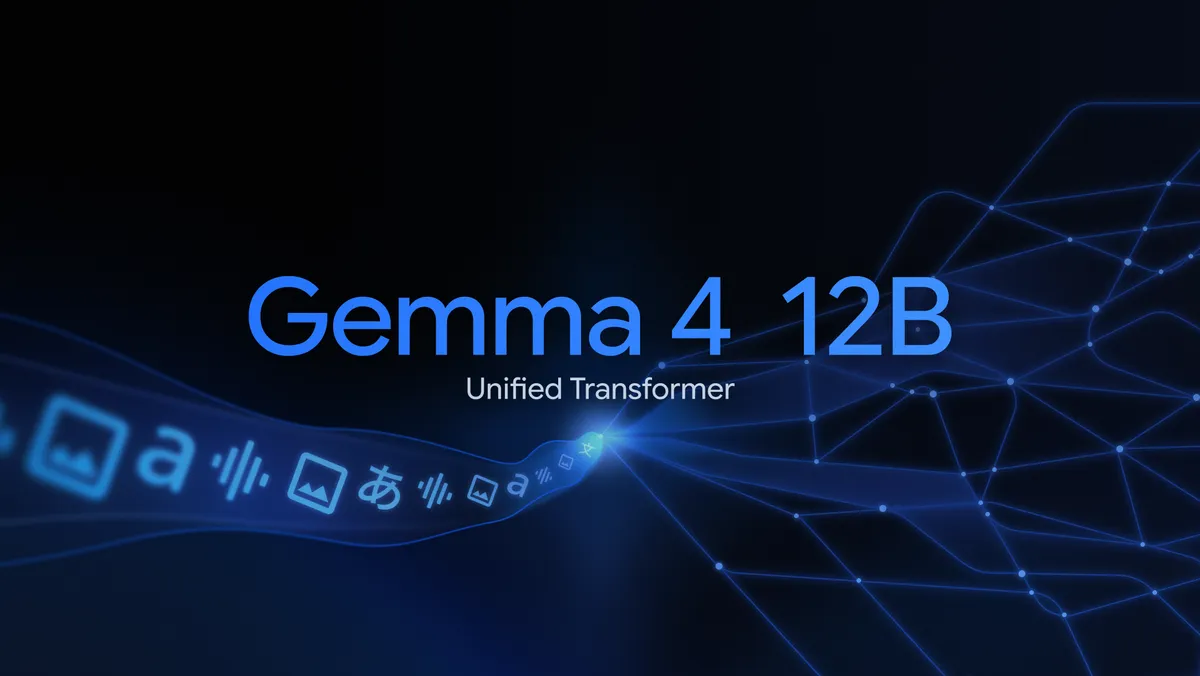
The architectural layout of the Gemma 4 12B Audio network avoids this context loss entirely by employing True Native Modality Training.
[Image illustrating the unified architecture where text, vision, and audio tokens process through a single core model]
Because the model was trained from day one to process text, vision, and raw acoustic frequencies simultaneously within a single core network, it doesn’t need to waste time translating audio into text files first. When you feed a raw audio wave file directly into the system, it processes the acoustic patterns natively. This allows the AI to catch the subtle emotional tones, vocal stress points, and environmental background noises that standard text-only chatbots miss completely, bringing a massive upgrade to modern voice applications.
4. Total Privacy Isolation: Voice Automation at the Local Edge
For technology buyers, security analysts, and digital platform managers who evaluate AI software through the lens of data compliance and privacy protection, the ultimate mountain modern software must climb is data exfiltration. Forcing private conversations, corporate meeting audio recordings, or personal voice commands through remote cloud servers creates massive security risks and leaves users exposed to potential corporate data leaks.
The open-source optimization of this framework fully answers this security threat by enabling Ironclad Offline Edge Operations.
Because the complete system fits beautifully within a lightweight 12GB memory footprint, you can run the entire model completely disconnected from the internet. Your raw voice recordings never travel to an external cloud server, ensuring your data remains completely private. This makes it an extraordinary option for sensitive industries like healthcare transcription, confidential legal documentation, and private customer service systems that require absolute information security.
The Verdict: Local Multi-Modal Audio Has Officially Arrived
The emergency patch and updated weights surrounding Gemma 4 12B Audio represent a stellar, masterfully executed victory for open-source optimization and localized AI edge computing. By matching a massive 5x processing speed boost with a lightweight memory footprint, native audio tokenization, and ironclad data privacy, the open-source community has delivered a legendary milestone that completely redefines the modern AI voice landscape.
Pros
- Spectacular Performance Leap: The emergency software patch unlocks a massive 5x speed boost, entirely eliminating old audio processing lag.
- Complete Privacy Freedom: Running the system completely offline on your own hardware guarantees total protection against external data tracking.
- True Native Audio Skills: The model processes acoustic waves directly, capturing the rich emotional nuances that text-only bots miss.
- Highly Compact Size: The compressed layout fits easily onto a single consumer graphics card, making advanced AI highly accessible.
Cons
- Strict Initial Requirements: Running the system smoothly requires a clean manual setup of the latest developer code and specialized model libraries.
- Strict Audio Length Limits: Local processing constraints currently cap incoming audio clips to a maximum of 30 seconds at a time to prevent memory issues.
To explore the official developer patch notes, analyze detailed system benchmarking metrics, and download the updated open-source model weights right from the source, you can skip right over to the comprehensive tracking at the Hugging Face Repository Space to watch exactly how this open-source voice revolution is unfolding!
What do you think?
Does the news that the open-source community has unlocked a massive 5x speed boost for running Gemma 4 12B Audio on local hardware make you ready to set up your own ultra-fast, secure offline voice assistants, or do you prefer the ease of using commercial cloud APIs? Let us know your thoughts in the comment section below!
For a broader, deep-dive look at how open-source developers, hardware engineers, and machine learning communities are collaborating to build high-performance, multi-modal software tools that run completely locally on consumer hardware, check out the in-depth technical analysis hosted over on the official TechRadar AI Hub. This comprehensive technology platform tracks all the latest repository merges, local hardware benchmarks, and open-weight model trends reshaping how we interact with technology.