The Creator’s New Default: ASUS ROG Zephyrus G16 (2026) GU606AM-TB055X
With Panther Lake and Blackwell RTX 5060 power, the 2026 Zephyrus G16 seamlessly bridges the gap between gaming rig and creative powerhouse.

Image Credits: PC Mag
For years, the high-end laptop market has forced us into a frustrating compromise. If you wanted raw, unthrottled rendering power, you had to carry around a plastic brick that screamed “gamer” and required a power adapter the size of a paving stone. If you wanted a sleek, gorgeous machine with an incredible display and all-day battery life, you had to sacrifice top-tier GPU performance.
The ASUS ROG Zephyrus G16 (2026) GU606AM-TB055X is here to argue that you don’t have to choose anymore.
By pairing Intel’s highly efficient 3nm Panther Lake architecture with NVIDIA’s Blackwell-generation RTX 5060, ASUS has crafted a machine that feels less like a traditional gaming laptop and more like a hyper-powered, all-purpose mobile studio. Whether you are compiling complex codebases, rendering procedurally generated motion graphics, or tackling intensive real-time design work, this hardware configuration hits an incredibly rare sweet spot.
Design and Build: Muted, Metallic, and Mature
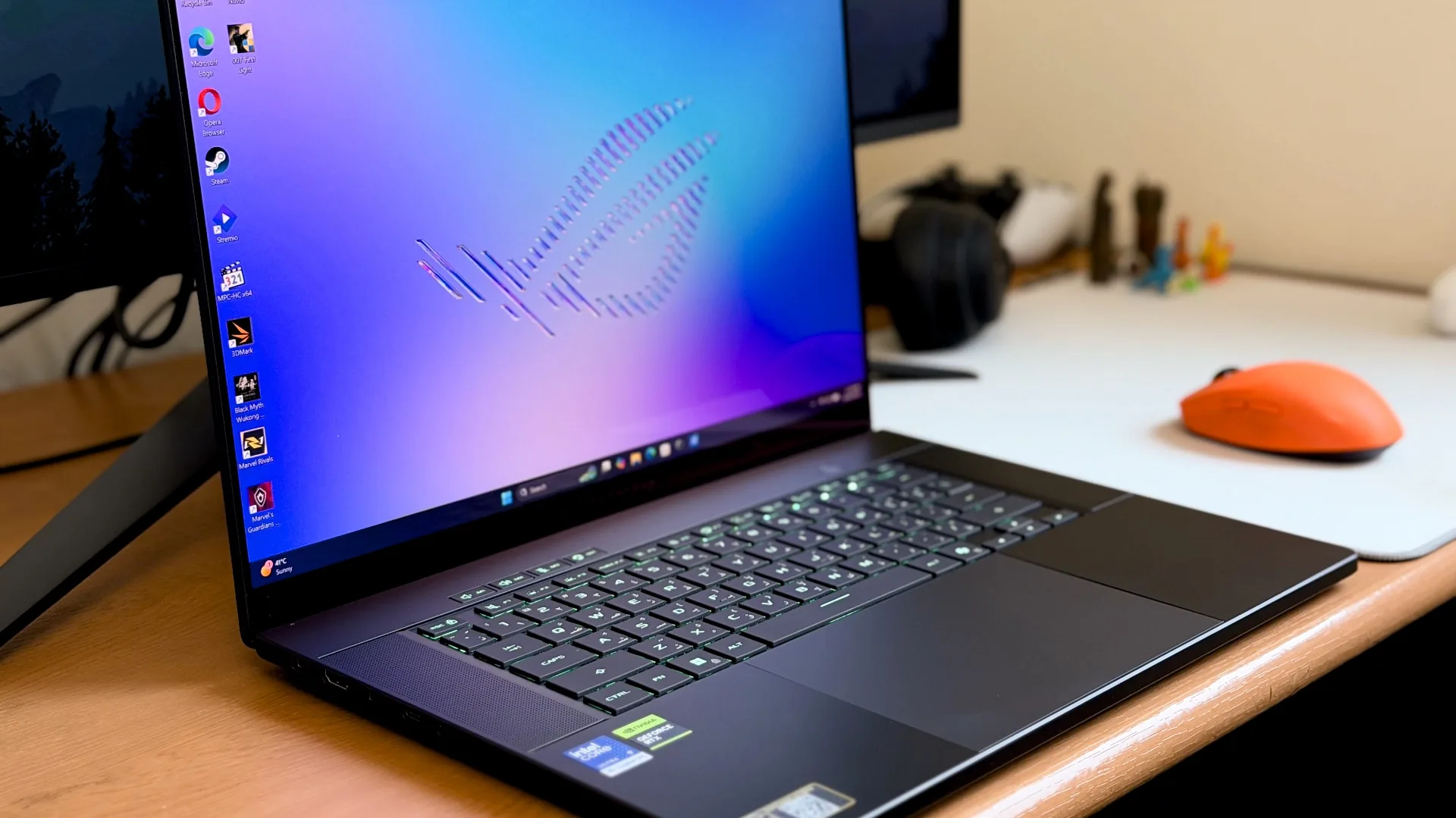
The first thing you notice about the Zephyrus G16 is its restraint. ASUS has leaned hard into a premium, CNC-milled aluminum unibody design that measures just 1.49 cm thin and weighs a highly portable 1.85 kg. It is remarkably rigid, with virtually zero keyboard flex or lid wobble.
The aesthetic is clean enough to sit on a boardroom table or in a creative studio without drawing unwanted stares. Instead of aggressive, aggressive RGB grills, the lid features a refined, single-diagonal “Slash Lighting” bar with customizable white LED patterns. It’s elegant, minimalist, and beautifully constructed.
Opening the laptop reveals a massive glass trackpad that is incredibly smooth to the touch, flanking a spacious, tactile keyboard with 1.7mm of key travel. Unlike many shallow, clicky ultrabook keyboards, this one offers a soft but defined bottom-out that is comfortable for long coding or writing sessions.
The Nebula OLED Display: A Visual Masterpiece
If there is one single feature that makes this machine an instant buy for visual artists, designers, and developers alike, it is the display:
- Size and Aspect Ratio: 16-inch, 16:10 aspect ratio, perfect for vertical timeline space in video editors and multiple code windows side-by-side.
- Resolution: 2.5K (2560 x 1600, WQXGA), providing razor-sharp text and pixel-perfect clarity.
- Panel Tech: ROG Nebula HDR OLED with a blazing-fast 240Hz refresh rate and a 0.2ms response time.
- Color and Brightness: 100% DCI-P3 color gamut, VESA DisplayHDR True Black 1000 certification, and a peak brightness of up to 1100 nits in HDR.
In practice, this screen is stunning. Colors pop with vibrant saturation without looking artificially oversaturated, and the infinite contrast ratio of OLED means blacks are truly black. For anyone working with vector design, canvas layouts, or precise UI/UX design, having delta E color calibration right out of the box is a game-changer. The 240Hz refresh rate also ensures that navigating the OS, scrolling through long web pages, and playing fast-paced games feel exceptionally fluid.
Performance: Panther Lake Meets Blackwell
The real magic of the GU606AM-TB055X lies under the hood, where ASUS has brought together some of the most advanced silicon available in 2026.
The Brains: Intel Core Ultra 9 386H
Built on Intel’s cutting-edge 1.8nm (18A) process node, the Core Ultra 9 386H represents a massive leap forward in x86 efficiency. It features a hybrid architecture with 16 cores and 16 threads, combining high-performance “Cougar Cove” cores with highly efficient “Darkmont” cores.
Unlike previous generations of Intel chips that ran hot and drained batteries in minutes, the 386H operates comfortably at a 25W base TDP but can scale all the way up to an 80W turbo boost when heavy rendering demands it.
Additionally, it features an integrated Neural Processing Unit (NPU) capable of 50 TOPS of local AI compute. This means tasks like real-time background blurring, speech-to-text processing, and on-device generative AI models run natively on dedicated silicon, keeping your CPU and GPU free for heavier tasks.
The Muscle: NVIDIA GeForce RTX 5060 Laptop GPU
Don’t let the “60-class” moniker fool you. Based on the Blackwell architecture, this mobile RTX 5060 is paired with 8GB of ultra-fast GDDR7 memory on a 128-bit bus. Because of the architectural leap, this card easily trades blows with, and often beats, previous-generation high-end laptop GPUs, all while consuming significantly less power.
For creators, this translates to effortless performance in 3D engines, swift real-time physics simulations, and seamless viewport performance in complex vector art and motion design suites.
Combined with a generous 2TB M.2 NVMe PCIe 4.0 SSD, asset loading is virtually instantaneous, and local scratch disks have plenty of breathing room.
Real-World Workflows: Creative Productivity & Development
While this laptop is branded under the Republic of Gamers (ROG) banner, its hardware profile reads like a dream machine for modern digital creators and developers:
1. Game Development & Engines
If you build in real-time environments like Unity, compiling scripts and baking lightmaps can easily choke lesser machines. The hybrid architecture of the Core Ultra 9 386H handles multi-threaded compilations with ease, while the RTX 5060 provides plenty of overhead to test complex scenes with hardware-accelerated ray tracing enabled.
2. Vector, Canvas, & Layout Tools
For those who live in lighter design environments, such as canvas-based web builders, vector layout programs (like Inkscape), or collaborative prototyping tools—the combination of the 240Hz OLED screen and the incredible single-thread speeds of the Cougar Cove processor cores means everything is hyper-responsive. There is absolutely zero lag when dragging massive vector groups or panning across dense project boards.
3. High-Fidelity Rendering & Motion Design
If you utilize modern procedural node networks or motion graphics suites (such as Cavalry), you know how quickly heavy coordinate math can bottleneck a system. The high-clocked single-core performance of the Core Ultra 9 makes real-time viewport previews buttery smooth, allowing you to iterate on complex animations without constantly waiting for previews to pre-render.
Portability, Ports, and Power
The Achilles’ heel of slim gaming laptops has historically been battery life and connectivity. ASUS has addressed both issues directly.
On the battery front, the G16 houses a large 90Wh battery. Thanks to the efficiency gains of the 3nm Intel CPU and the Max-Q technologies built into NVIDIA’s Blackwell architecture, you can easily get through 7 to 8 hours of moderate productivity work (like web development, writing, or content consumption) without needing an outlet.
When you do need to plug in, you are spoiled for choice. The laptop comes with a high-capacity 250W main power adapter for full-tilt performance, but both USB-C ports support up to 100W of Power Delivery. This means you can toss a compact, universal travel charger into your bag for day-to-day office runs.
The port selection is exceptionally generous for a chassis this thin:
- Left Side: Proprietary DC-in, HDMI 2.1, 1x USB-C Thunderbolt 4, 1x USB-A 3.2, and a 3.5mm combo audio jack.
- Right Side: 1x USB-C Gen 2 (supporting DisplayPort and Power Delivery), 1x USB-A 3.2, and a dedicated SD Express 7.0 UHS-II card reader, a massive plus for designers transferring raw project files.
Conclusion: The Ultimate All-Rounder
The ASUS ROG Zephyrus G16 (2026) GU606AM-TB055X is an incredibly refined machine. It manages to deliver workstation-class performance, a world-class OLED display, and executive-level aesthetics in a body that weighs under 2 kilograms.
While it carries a premium price tag, it justifies every penny by removing the friction from your creative and technical workflows. If you need a single, uncompromising machine that can write code, render motion graphics, run real-time engines, and play the latest AAA games at high frame rates, all while fitting comfortably into a standard backpack, this is the laptop to beat in 2026.