How NVIDIA’s Software Stack Drives Token Costs to Near Zero
NVIDIA’s inference software stack optimizes total cost of ownership (TCO) and minimizes token costs.

As artificial intelligence shifts out of experimental laboratories and into global production, the primary economic engine of the industry has radically changed. Data centers are no longer just storage facilities; they are AI factories, and their primary commodity is the token.
Whether it is a line of code generated for a software engineer, a medical diagnostic insight, or an autonomous reasoning chain from an AI agent, the fundamental unit of measurement is the cost per million tokens.
While massive hardware upgrades like the liquid-cooled Blackwell (GB300 NVL72) architecture grab headlines, hardware alone isn’t what makes scaling affordable. The unsung hero driving down AI production costs is NVIDIA’s integrated, full-stack inference software. By pairing specialized hardware with dynamic software compilation, NVIDIA has dropped token costs by up to 35x over the previous Hopper generation, turning complex agentic workflows into highly profitable business ventures.
1. Why Software is the True Driver of Tokenomics
When considering the cost of running large language models (LLMs), a simple hardware formula falls short. Renting or owning a high-end GPU cluster incurs a static hourly overhead. The only way to decrease the cost per token is to drastically increase the throughput (how many tokens the hardware can process per second) and ensure maximum resource utilization.
NVIDIA’s inference stack achieves this by operating synchronously across three key layers:
- Infrastructure Access & Low-Level Precision (CUDA & NVFP4): Optimizing how data moves inside the silicon.
- Application Acceleration (TensorRT-LLM & SGLang): Rewriting how the neural network compiles and schedules mathematical operations.
- Production Orchestration (NVIDIA NIM): Packaging models into deployment-ready microservices that auto-scale and load-balance across data centers.
2. Technical Leaps Driving Down the Cost Curve
The massive 35x drop in token cost achieved by platforms like Blackwell isn’t down to raw processing power alone. It relies on a compounding chain of core software innovations:
NVFP4 Precision Engine
Moving from traditional FP16 (16-bit floating-point) down to FP8, and now native NVFP4 (4-bit floating-point) precision, allows models to take up significantly less memory footprint. NVIDIA’s software stack handles this quantization seamlessly without degrading model accuracy. By reducing the memory footprint, a single GPU can hold vastly larger models or run massively larger batch sizes, instantly multiplying token throughput.
Disaggregated Serving
In traditional inference setups, the Prefill phase (processing the user’s prompt input) and the Decode phase (generating tokens one by one) share the same GPU resources. Because these two phases have completely different compute and memory profiles, they constantly bottleneck each other.
NVIDIA’s software stack leverages disaggregated serving, separating the prefill and decode phases across distinct nodes or GPUs within an NVLink network. This eliminates compute stalls, keeping GPU utilization hovering near maximum capacity.
In-Flight Batching & Multi-Token Prediction
Traditional batch processing forces a system to wait for the longest sequence to finish generating text before accepting new requests. NVIDIA’s runtime introduces in-flight batching. The software immediately evicts finished sentences from a running batch and slots new user requests into the vacant processing tracks mid-cycle. Paired with multi-token prediction algorithms, the software stack guesses and computes multiple tokens simultaneously rather than one at a time, dramatically shortening the Time to First Token (TTFT).
3. Real-World Impact: The API Crossover Point
For startups and enterprise developers, this software architecture completely alters the “Build vs. Buy” equation. Historically, developers relied heavily on closed cloud APIs (charging fixed rates like $3 per million input tokens / $15 per million output tokens) because self-hosting on raw GPUs was too expensive and unoptimized.
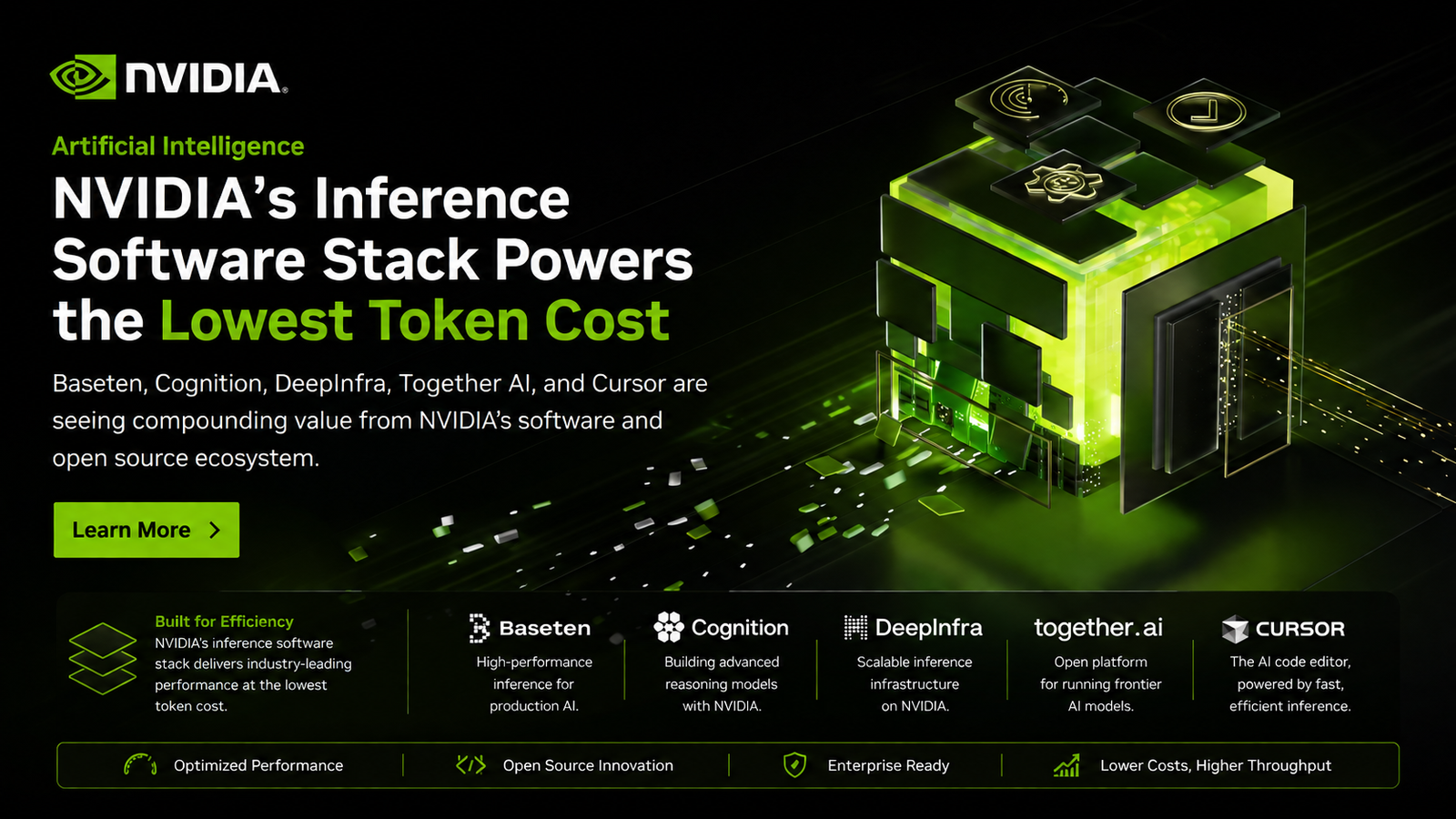
Now, leading inference providers (such as DeepInfra, Together AI, Baseten, and Fireworks AI) utilize NVIDIA’s software stack on Blackwell clusters to drop operational token costs down to fractions of a cent.
When an enterprise processes over 500 million tokens monthly, deploying downloadable NVIDIA NIM (NVIDIA Inference Microservices) containers within an enterprise cloud platform becomes significantly cheaper than external APIs. The software handles the complex load balancing, health checks, and orchestration out-of-the-box, giving developers raw metal performance with the simplicity of a standard REST API.
4. Open-Source Ecosystem Integration
NVIDIA hasn’t built a walled garden for its inference stack; instead, it co-designs its acceleration libraries directly with the open-source community. Day-zero support for frontier models (like the DeepSeek-V4 or Llama series) is achieved through native integrations with PyTorch, vLLM, and SGLang.
By ensuring that community-driven execution engines compile flawlessly into native CUDA and TensorRT architectures, developers can instantly port the newest open-weight models onto high-throughput infrastructure without rewriting their application logic.
The Bottom Line
As AI transitions into multi-step agentic workflows that require thousands of background tokens to solve a single user query, token efficiency is business survival. NVIDIA’s relentless hardware-software codesign proves that real performance gains aren’t just minted in silicon fabrication labs—they are unlocked line by line in the compiler software. By maximizing throughput per watt and per dollar, the software stack makes the next generation of computing economically viable at global scale.