The Anthropic Microsoft NVIDIA Alliance That Destroys Cloud AI Bottlenecks
Anthropic’s Claude partners with Microsoft Azure and NVIDIA, supercharging enterprise workflows with next-gen GB300 NVL72 rack-scale infrastructure.

Let’s be honest: the absolute biggest bottleneck in the artificial intelligence race right now isn’t the software engineering, it is the brutal physical reality of computing infrastructure. If you have tried running heavy enterprise AI workflows or deploying multi-agent code repositories lately, you have probably run face-first into annoying latency lags or unexpected cloud server timeouts. As software models grow more complex, running them on yesterday’s server setups is like trying to race a Ferrari through a muddy, single-lane dirt road.
A massive trio of tech giants has joined forces to completely obliterate this infrastructure hurdle.
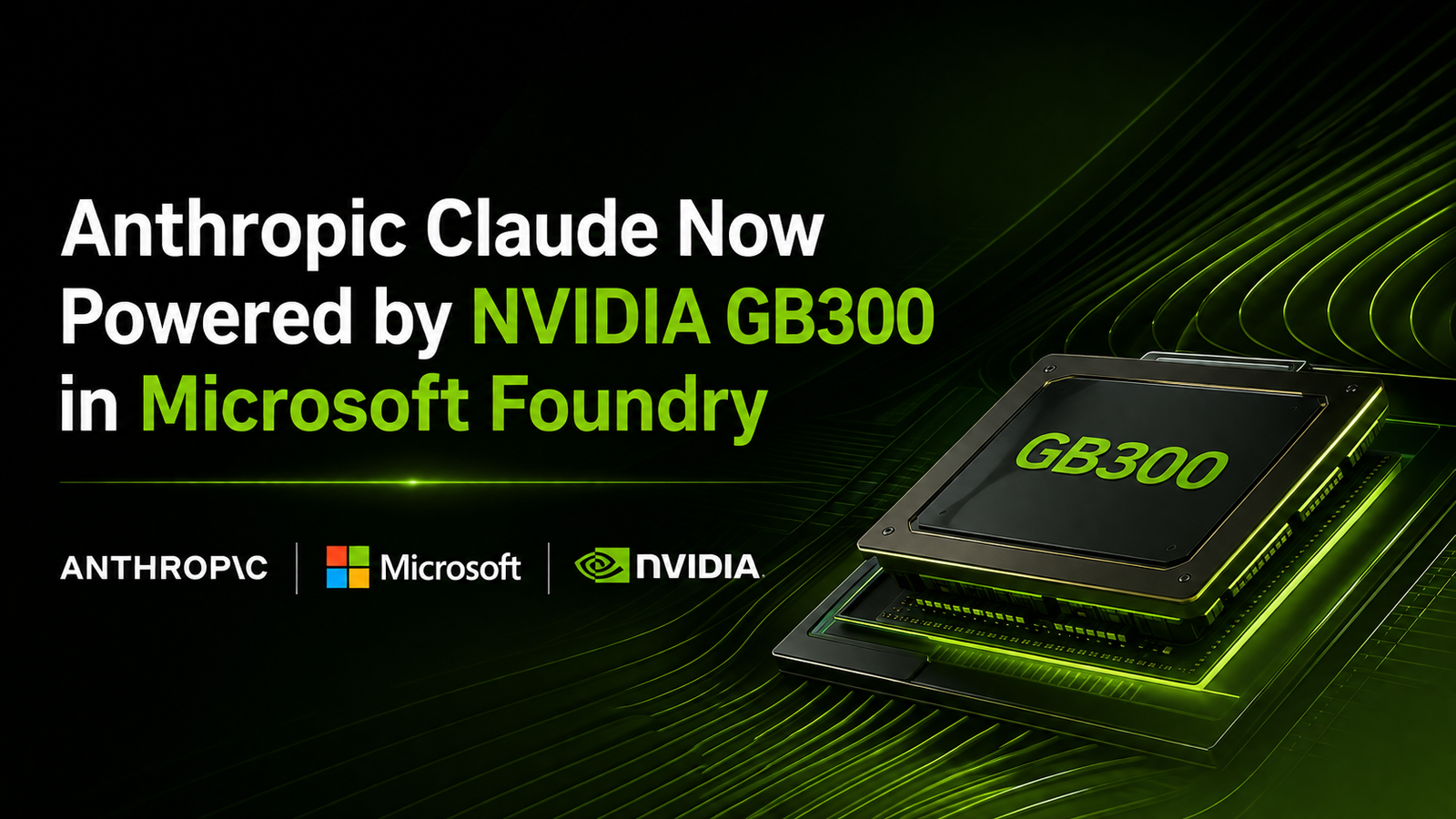
Anthropic, Microsoft, and NVIDIA have officially unified their hardware and software stacks. By making Anthropic Claude generally available on NVIDIA GB300 NVL72 architectures within the Microsoft Azure Foundry ecosystem, this partnership introduces a massive, liquid-cooled shot of adrenaline to enterprise cloud computing.
What Is a Rack-Scale AI Factory?
To understand why the announcement is sending shockwaves through the tech community, we need to look past standard consumer graphics cards. We aren’t talking about plugging a single new component into a server motherboard. The NVIDIA GB300 NVL72 platform is an absolute beast of a rack-scale system that treats an entire cluster of 72 individual Blackwell GPUs as a single, massive, unified supercomputer.
Older server clusters operated like a group of independent workers constantly shouting instructions across a noisy room. Every time one chip needed to share data with another, it had to send information through slow, traditional motherboard channels, causing massive bottlenecks.
The GB300 NVL72 architecture fixes this completely by weaving all 72 chips together using a massive, high-speed NVLink interconnect network. This network delivers an astonishing 130 terabytes per second of bidirectional bandwidth. This means the entire rack shares a massive pool of memory, allowing Claude to process massive enterprise databases instantly, without waiting for data to slowly copy back and forth between isolated components.
Quantum-X800 InfiniBand: The Zero-Latency Highway
Even the fastest server rack in the world can still get bogged down if it can’t talk to other server racks across the data center quickly enough. If you are building complex, real-time applications like live voice interfaces or autonomous developer agents that need to process hundreds of code files simultaneously, network lag is an absolute killer.
To clear this hurdle, Microsoft Azure is backing these new clusters with NVIDIA Quantum-X800 InfiniBand networking hardware.
Instead of traditional ethernet connections that get congested easily under heavy traffic loads, this elite networking layout acts like a dedicated, ultra-low latency highway that links multiple GB300 racks together. Pumping out data at a blistering 800 Gigabits per second per port, it ensures that when Claude scales up to handle massive, multi-step reasoning tasks, the communication between different server pods remains flawlessly crisp and instantaneous.
Real-World Impact: What This Means for Everyday Workloads
So, why does a software engineer, tech blogger, or enterprise administrator actually care about this deep data center partnership? Outside of impressive numbers on a hardware spec sheet, this upgrade completely fundamentally changes how it feels to interact with Claude in a production environment:
- Instantaneous Token Delivery: The combination of Blackwell silicon and InfiniBand networking means text and code generation speeds skyrocket, cutting down the waiting time for complex debugging passes to the blink of an eye.
- Massive Multi-Agent Coordination: If you are building a system where multiple autonomous agents need to talk to each other to handle complex tasks like automated software testing, the zero-latency backend prevents the entire chain from stalling out.
- Flawless Enterprise Privacy: Because this environment is baked directly into the secure Microsoft Azure Foundry framework, your private codebases, financial sheets, and sensitive company records never leak into public training pools.
Mapping the Enterprise Cloud Spectrum
To see how this new Microsoft Azure and NVIDIA hardware integration alters the competitive cloud landscape, let’s look at how it compares to older enterprise deployment setups:
| Cloud Architecture Layer | New Azure Foundry Standard | Traditional Cloud Compute | Operational Workflow Impact |
| Core Silicon Foundation | NVIDIA Blackwell GB300 | Legacy Hopper Architecture | Drastic Speed Advancements |
| Rack-Scale Unity Status | Fully Integrated NVLink72 | Segmented Multi-Card Boards | Zero Inter-Chip Bottlenecks |
| Networking Infrastructure | Quantum-X800 InfiniBand | Standard 400G Ethernet | Flawless Zero-Lag Pipeline |
| Model Optimization | Native Anthropic Weights | Custom API Translation Layers | Minimal Computational Overhead |
| Data Privacy Guardrails | Isolated Azure Governance | Shared Public Server Hubs | Government-Grade Security |
| Real-Time Token Output | Maximum Unthrottled Delivery | Throttled Peak-Hour Queues | Consistent Production Velocity |
Looking at the numbers, it is clear that we are moving out of the early, experimental era of AI web tools and heading straight into deep, industrial-grade integration. The teams that win over the next few years won’t just be the ones with the smartest models; they will be the teams that run their software on highly optimized, deeply integrated hardware pipelines.
The Economics of the Premium Cloud Stack
There is an unavoidable reality that every tech lead has to face when looking at these specs: the cost of premium infrastructure. Renting time on high-end Blackwell NVL72 clusters inside Microsoft Azure is a serious capital commitment compared to basic, entry-level cloud APIs. If you are just using an AI model to summarize occasional emails or draft casual blog copy, paying for this level of extreme computing power is undeniably overkill.
But for organizations that build their entire product on top of real-time AI generation, the return on investment speaks for itself. Reducing response latencies from seconds down to milliseconds completely changes the user experience, boosting active engagement and dropping user drop-off rates down to zero.
When you factor in the massive efficiency gains of liquid-cooled data centers and the ironclad security of Azure Foundry, this infrastructure stack becomes an essential tool for high-performance deployment.
If you are currently fine-tuning your own platforms, troubleshooting backend connections, or designing responsive frontend layouts for complex software applications, having a clean technical foundation makes a world of difference. You can find detailed, practical walkthroughs on optimizing user interfaces and streamlining developer toolsets by reading through our comprehensive tech design guides over at ForanTech.
Ultimately, the unified front shown by Anthropic, Microsoft, and NVIDIA points to a fascinating future. We are watching the hardware and software layers of the tech world melt together completely, building a lightning-fast foundation for the autonomous applications of tomorrow.
For the full, unabridged enterprise declaration detailing specific regional data center availability matrices, subscription tier structures, and API integration documentation, check out the official announcement published directly on the Microsoft Azure Core Product Newsroom.
How do you view this deep hardware alliance between Anthropic and Microsoft Azure? Is your team looking to migrate your heavy automated coding pipelines over to dedicated Blackwell clusters to get zero-latency performance, or are you comfortable using standard cloud APIs for your daily tasks? Let us know what you think down in the comment section below.