Zhipu AI’s GLM-5.2: A New Competitor in the AI Market?
Zhipu AI triggers massive market shifts as its newly released open-weight GLM-5.2 model directly challenges top-tier Western AI.

The global artificial intelligence landscape has entered a volatile new phase where open-weight architecture is directly challenging the market hegemony of closed-source Western frontier models. Driven by intense developer intrigue and a massive surge in commercialization optimism, Beijing-based Zhipu AI (trading publicly under the name Knowledge Atlas Technology on the Hong Kong Stock Exchange) has officially crossed a historic market valuation milestone of 1 trillion HK dollars (approximately 128 billion U.S. dollars).
This 1,900% cumulative market gain since the company’s January listing has been catalyzed by the open-source release of its latest flagship model, GLM-5.2. Boasting an expansive 1 million-token context window and specialized “Thinking Modes,” the model is performing at near-parity with premium closed-source platforms like OpenAI’s GPT-5.5 and Anthropic’s Claude Opus 4.8—all while operating at a fraction of their per-token inference costs.
Under the Hood: The IndexShare Architecture and Code Dominance
The technical architecture of GLM-5.2 represents a massive generational leap over its mid-spring predecessor, GLM-5.1. The 753 billion-parameter model, released under an unrestricted, open-source MIT license, directly targets long-horizon software engineering and complex, multi-turn agentic workflows.
To practically serve a 1 million-token context window without causing extreme hardware bottlenecks or massive memory overheads, Zhipu AI implemented a proprietary mathematical optimization called IndexShare. Traditional dense models run an independent token indexer at every single transformer layer, which spikes computation requirements during long-prompt executions.
With IndexShare, every group of four transformer layers shares a singular, lightweight indexer placed at the front of the block. This architectural compression drastically drops the required dot-product operations, allowing developers to compress the model from its native 1.51TB footprint down to just 238GB using quantized 2-bit GGUF weights. This level of optimization allows enterprise teams to deploy a frontier-tier coding model locally on local infrastructure equipped with 256GB of RAM or VRAM, eliminating cloud data dependencies entirely.
Cross-Border Benchmarks and Pricing Dynamics
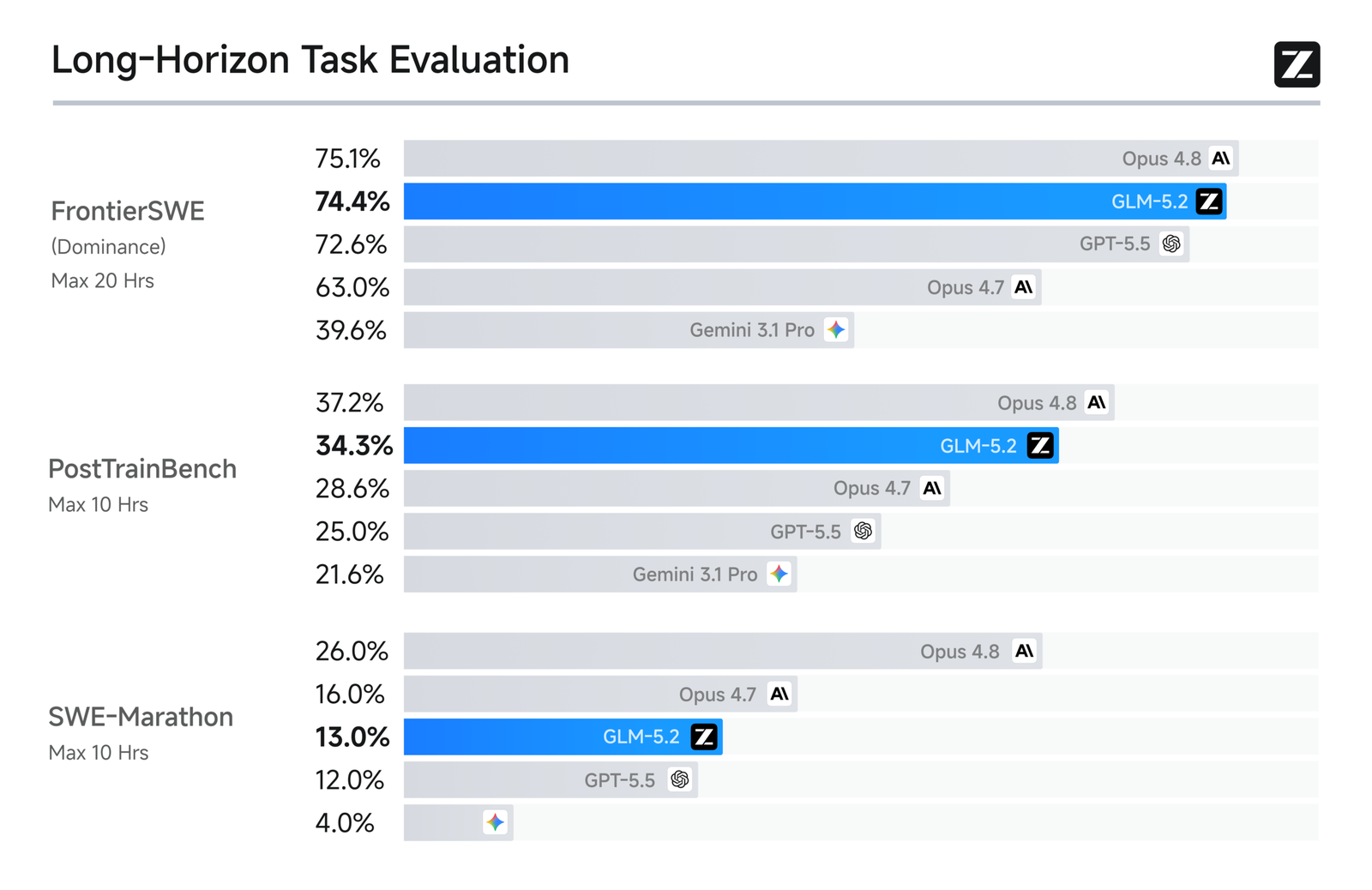
The emergence of GLM-5.2 has generated significant concern across Silicon Valley development circles due to its high score profiles on industry-standard third-party tracking metrics. In the open-ended FrontierSWE (Dominance) benchmark—which evaluates an AI agent’s capacity to resolve complex, real-world systems optimization and large-scale code compilation over multi-hour windows—GLM-5.2 achieved a 74.4% success rate.
This score places the open-weight model ahead of OpenAI’s GPT-5.5 (72.6%) and trails Anthropic’s flagship Claude Opus 4.8 by a razor-thin margin of only 1.1%.
| Architectural Vector | Zhipu AI GLM-5.2 (Open-Weight) | OpenAI GPT-5.5 (Closed API) | Anthropic Claude Opus 4.8 (Closed API) |
| FrontierSWE Rating | 74.4% | 72.6% | 75.1% |
| Context Window Size | 1.0 Million Tokens | 1.0 Million Tokens | 2.0 Million Tokens |
| Input Cost (Per 1M) | $1.40 | $5.00 | $15.00 |
| Output Cost (Per 1M) | $4.40 | $15.00 | $75.00 |
| License Framework | Open MIT License | Proprietary Commercial | Proprietary Commercial |
The most disruptive aspect of GLM-5.2 lies in its aggressive market pricing structure. Zhipu AI has positioned its API pricing at $1.40 per million input tokens and $4.40 per million output tokens. By undercutting premium Western alternatives by up to 82%, the model has introduced massive cost-efficiency pressures into the enterprise market, driving an increasing number of global tech firms to experiment with open-source, self-hosted alternatives to bypass expensive cloud token expenditures.
Geopolitical Adoption and the Sovereign Cloud Shift
The commercial trajectory of Zhipu AI highlights a deep structural bifurcation in global technology adoption. While the U.S. Commerce Department maintains active restrictions on Zhipu AI due to national security friction, the company has heavily accelerated its international footprint by establishing new regional offices in major tech hubs like Singapore and Dubai.
This geographic expansion aligns with a broader market shift toward what international analysts define as “sovereign cloud infrastructure.” As the U.S. government tightens access permissions and imposes strict pre-release vetting schedules on domestic developers, global enterprises in Southeast Asia and the Persian Gulf are prioritizing operational reliability.
Because an open-weight model like GLM-5.2 can be completely downloaded, audited, and run entirely offline, it insulates international platforms from sudden geopolitical policy shifts or revoked API access tokens. Consequently, Zhipu’s registered developer ecosystem has expanded to over 4 million active accounts spanning 218 countries, establishing deep software standards across emerging enterprise markets well before closed-source alternatives can clear domestic regulatory review hurdles.
How do you view the competitive balance between expensive, closed-source frontier APIs and optimized, low-cost open-weight models like GLM-5.2? Let us know your thoughts in the comments section below.
For complete deployment step-guides, local hardware configuration scripts, and real-time token processing latency tracking, visit the updated developer databases at forantech.com.
External News Sources:
- For an expansive breakdown of the market dynamics, trading volumes, and index inclusions surrounding the company’s valuation milestone, review The Hong Kong Financial Bureau Market Briefing.
- For a detailed technical overview of the model’s performance on the Code Arena matrix and SWE-bench pipelines, read the full Silicon Valley Enterprise Tech Analysis.