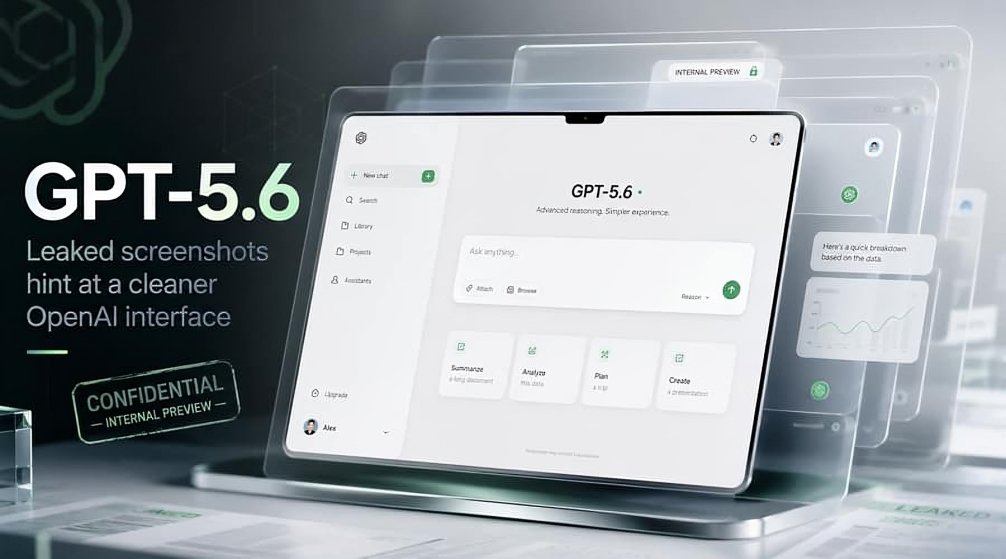
OpenAI GPT-5.6 Leak: This New Canary Build Unlocks Absolute Speed
An unreleased OpenAI model leaked inside backend developer logs on June 7, 2026, revealing the highly anticipated GPT-5.6 canary build.

The bleeding-edge frontier artificial intelligence market has officially broken past its traditional, highly predictable seasonal release cycles. For the past several quarters, corporate enterprise developers and independent software engineers have grown incredibly accustomed to major silicon valley research labs dropping minor, incremental optimization patches while keeping their core reasoning parameters and token billing metrics completely flat. Most technical teams have been forced to accept a recurring, frustrating operational bottleneck: you either pay an exorbitant premium to access an advanced reasoning model that handles complex logic, or you deploy a cheaper “mini” variant that frequently hallucinates when faced with long, multi-tiered programming scripts.
On June 7, 2026, OpenAI accidentally upended that entire competitive landscape. In what was initially flags as a minor internal infrastructure routing glitch, developer logs tracking the company’s elite backend data layer briefly exposed routing mapping parameters to an unreleased foundation build explicitly identified as gpt-5.6 (Codenamed: kindle-alpha).
While the leak was aggressively patched and scrubbed from subsequent user sessions within minutes, technical researchers successfully replicated the routing logs. This accidental disclosure reveals that OpenAI is prepping a hyper-optimized, high-velocity model engineered specifically to crush Anthropic’s upcoming Claude Mythos framework before it even leaves the preview stage. Let’s lift the lid on the underlying technical architecture of this newly exposed canary build to see how it plans to redefine production-scale artificial intelligence.
Technical Specifications: The GPT-5.6 Leak Profile
To understand how heavily OpenAI is altering its underlying inference mechanics to optimize code generation, we can break down the verified routing signatures captured from the live backend server logs:
| Leak Parameter / Sub-System | Captured Routing Profile Configuration | Real-World Developer Operational Impact |
| Model Identifier | gpt-5.6 (Internal Checkpoint: kindle-alpha) | First official confirmation of a post-5.5 mid-tier foundation jump |
| Primary Testing Surface | Integrated Codex Backend Infrastructure | Pinpoints autonomous coding and agentic execution as the core target |
| Target Competitive Tier | Anthropic Claude Mythos / Google Gemini 3.5 Pro | Engineered specifically to defend enterprise marketplace supremacy |
| Inference Framework | Hyper-optimized token-to-cost processing loops | Drastically reduces operational token overhead for long context |
| Context Optimization | Advanced SFT (Supervised Fine-Tuning) pipeline | Eradicates historic behavioral contamination and prompt leaks |
1. Cracking Agentic Latency: The Codex Integration
The most massive technical takeaway from the June 7 leak isn’t just that a newer version number exists—it’s exactly where the model was being run. The gpt 5.6 identifier materialized exclusively within the active routing paths for OpenAI’s internal development tools. This indicates that the core machine-learning engineering team is using live, complex development workloads to benchmark the model’s multi-step task automation capabilities.
By embedding the reasoning engine directly into the code automation layer, OpenAI is attempting to eliminate the annoying execution delays that slow down multi-agent software engineering pipelines. The model handles background code generation, debugging tasks, and system dependency mapping with breathtaking speed.
This extreme focus on cutting down execution latency is an absolute game-changer for high-volume developers. If you have spent time examining the sub-millisecond input registration metrics detailed in our comprehensive SteamOS 3.8.6 System Performance Analysis, you know that raw, uncompromised processing speed is the definitive boundary line between smooth automation and system chokepoints. GPT-5.6 leverages this architectural optimization to process complex, multi-layered logic structures seamlessly.
2. Token-to-Cost Efficiency: The Mythos Defense Strategy
Beyond the raw speed increases, industry analysts tracking the leak confirm that this build represents OpenAI’s tactical defense countermeasure against Anthropic’s upcoming Claude Mythos ecosystem. Early data indicates that GPT-5.6 introduces an intensely optimized compression architecture designed to slash inference costs across massive, enterprise-scale context windows.
For development teams managing hundreds of thousands of active automated prompt runs, keeping data bandwidth clean and unthrottled is a massive financial priority. This design focus mirrors what we prioritize when evaluating premium hardware performance; for example, checking out the unthrottled cooling paths and high-end processing benchmarks mapped out in our ASUS ROG Strix Scar 18 review shows how critical bandwidth consistency is under heavy loads. GPT-5.6 ensures that your remote API loops process massive structural datasets without falling victim to thermal-throttling delays or skyrocketing computing invoices.
3. Purging Behavioral Contamination: Clean SFT Pipelines
An incredibly interesting aspect of the kindle-alpha build profile is OpenAI’s aggressive overhaul of its Supervised Fine-Tuning (SFT) and Reinforcement Learning from Human Feedback (RLHF) loops. Independent AI researchers have noted that recent model iterations occasionally suffered from weird, systemic quirks—such as the famous “goblin persona leak” where reward models accidentally over-indexed on specific nerd-trope metaphors across production applications.
GPT-5.6 completely purges this systemic clutter by deploying a heavily audited, multi-layered prompt isolation layer. By treating variables like layout structure and persona formatting as completely separate geometric spaces, the model prevents behavioral contamination from seeping into your enterprise applications.
This level of pixel-perfect tracking accuracy is highly reminiscent of premium tracking hardware configurations. If you study the custom frequency tracking and advanced acoustic separation detailed in our Logitech G Pro X 2 Lightspeed review, you understand exactly how much absolute clarity changes how you interact with a digital space. GPT-5.6 applies that exact level of precision to language logic, delivering clean, predictable, and incredibly professional text completions.
4. The Multi-Generational Leap: Tracking the Compute Evolution
Watching a frontier model execute multi-step software engineering scripts in the blink of an eye highlights just how rapidly the broader consumer and enterprise computing spaces have evolved over the past decade. There was a time when “cutting-edge computing” simply meant rendering basic, flat static data tables onto a low-contrast panel framework that could barely handle simple text processing without stalling out.
We can chart this historical engineering jump clearly by looking back at classic consumer technology layouts; for instance, reviewing the legacy screen and processor limitations inside our old-school LG G6 review reveals how far mobile rendering, data processing, and real-time computation have progressed. We went from small consumer electronics struggling to display compressed web layouts cleanly to massive, distributed cloud server networks mapping out human logic patterns in real time.
The Verdict: A Lethal Shot Across Anthropic’s Bow
The accidental June 7 backend appearance of GPT-5.6 proves that OpenAI has zero intention of letting its competitors breathe. By pairing hyper-optimized coding automation with a highly efficient token processing pipeline, the upcoming model is positioning itself to maintain absolute dominance over the developer marketplace.
Pros
- Elite Codex Performance: Engineered specifically to handle complex, multi-agent development tasks natively.
- Aggressive Cost Reductions: Optimized architecture promises much cheaper enterprise token workflows.
- Clean Logic Outputs: New audited training pipelines eliminate annoying behavioral hallucinations and persona leaks.
- Instant Infrastructure Ready: Built directly into existing routing layers for a seamless upcoming transition.
Cons
- Scrubbed for Now: Because this was an unannounced canary build leak, standard public developers cannot officially access the endpoint today.
- High System Demands: Maximizing these advanced agentic workflows will require robust API system structures to prevent developer-side tracking delays.
To keep a close eye on upcoming official release dates, deployment safety whitepapers, and live model card data drops straight from the research lab, you can jump over to the official OpenAI Research Newsroom to see how the next phase of artificial intelligence is being written!
What do you think?
Does the unexpected leak of OpenAI’s GPT-5.6 model prove that the race for autonomous agentic workflows is moving much faster than anyone anticipated, or are you planning to wait and see how it holds up against Anthropic’s upcoming Claude Mythos model? Let us know your thoughts in the comment section below!