ASUS ROG Ally X20: The limited edition OLED Handheld PC
ASUS completely stunned Computex on June 1, 2026, unveiling the ROG Xbox Ally X20 bundled with premium AR smart glasses.

The portable PC gaming industry has official graduated from its experimental first phase into a highly sophisticated, hyper-premium hardware arms race. For the last two years, portable enthusiasts have essentially been forced to accept a recurring visual limitation: you could either have an incredibly fast system that chewed through frame rates, or a device with an immaculate, vibrant panel that suffered from terrible battery life or a clunky design.
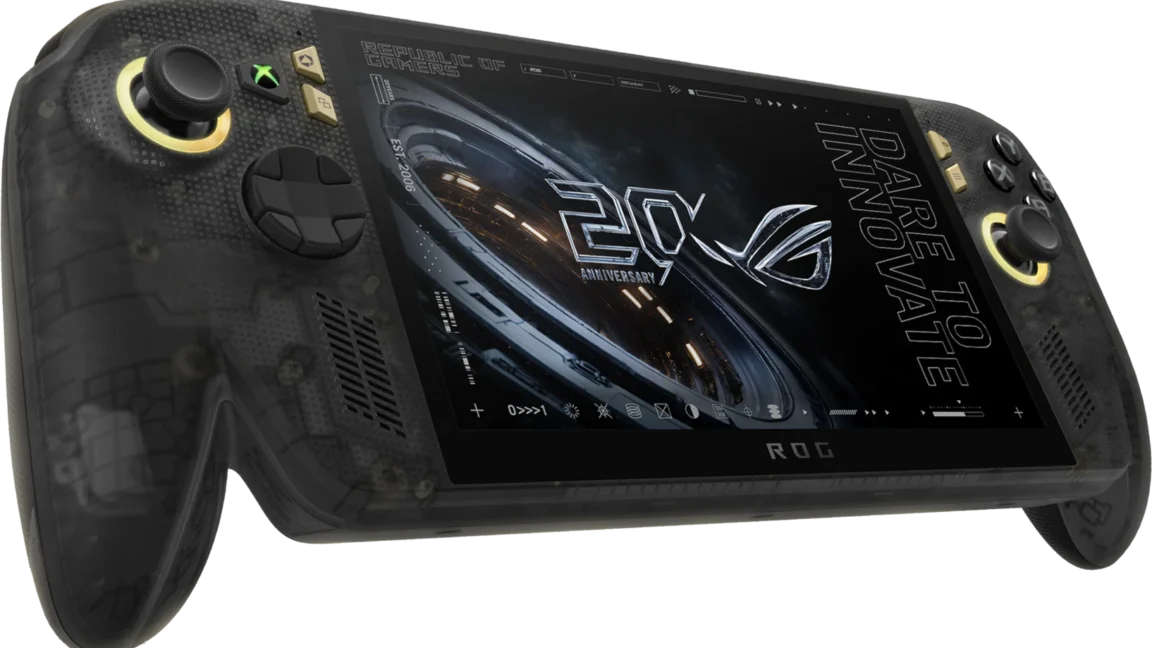
On June 1, 2026, ASUS officially shattered that standard on the ground floor of Computex 2026 in Taipei. Celebrating a major milestone anniversary for its Republic of Gamers brand, the company pulled back the curtain on its most ambitious collector’s piece to date: the ASUS ROG Xbox Ally X20 bundle.
Ditching standard mobile screens entirely to deliver a hyper-premium, translucent black chassis with an intricate gold internal structure, this handheld represents a fundamental paradigm shift in mobile immersion. By introducing a breathtaking, high-luminance display alongside a dedicated augmented reality headset integration right out of the box, ASUS is no longer just building a portable console—they are engineering a pocket-sized home theater ecosystem.
Technical Specifications: The Ally X20 Architecture Blueprint
To truly appreciate how heavily ASUS has re-engineered its flagship platform, let’s look directly at the factory-certified component array packed inside this anniversary release:
| Hardware Subsystem | Factory Target Configuration Profile | Real-World Operational Impact |
| Primary Display | 7.4-Inch Nebula HDR OLED Panel (1080p Resolution) | Spectacular TrueBlack 1000 contrast with deep visual depth |
| Peak Luminance | up to 1,400 Nits Max Brightness (Shatters previous 500-nit cap) | Flawless outdoor readability under direct sunlight conditions |
| Variable Refresh Rate | True Hardware VRR ranging from 30Hz to 120Hz | Smooth screen tracking that completely eliminates panel tearing |
| Joystick Hardware | Custom TMR (Tunneling Magnetoresistive) Sensor Sticks | Total permanent immunity to mechanical analog stick drift |
| Processor Engine | AMD Ryzen Z2 Extreme (8 Cores / 16 Threads, 15-35W TDP) | Rock-solid, flatline stability during intense open-world titles |
| AR Companion Glasses | ROG Xreal R1 Edition 20 Wearable Display System | Projects a massive 171-inch virtual screen running at 240Hz |
1. The OLED Revolution: Nebula HDR and 1,400 Nits
Historically, Windows-based handheld gaming computers have lived under a massive shadow when it came to panel vividness. While alternative platforms slowly transitioned to high-contrast screens, early iterations of high-spec Windows portables were physically constrained by standard IPS LCD technology. This meant dark, atmospheric horror games or high-contrast science fiction titles often looked slightly washed out, with muddy gray tones replacing true, cinematic blacks.
The ROG Xbox Ally X20 completely rewrites this visual story by elevating the display profile to a gorgeous 7.4-inch Nebula HDR OLED screen. Boasting a coveted VESA DisplayHDR TrueBlack 1000 certification alongside full Dolby Vision processing, the visual depth on display is absolute perfection.
Because each pixel emits its own light, contrast ratios scale up to near-infinite territory. When moving through brightly lit neon corridors or deep space tracking environments, the separation between blinding highlights and absolute void black is stunning. Combined with a massive leap to 1,400 nits of peak brightness, this hardware ensures that tracking target layouts remains crisp, clear, and perfectly visible even when gaming directly outdoors under the midday sun.
2. Breaking Boundaries: The 171-Inch Virtual AR Pipeline
While the integrated OLED screen is a massive win for standard portable play, the true “cheeky” wildcard feature of the Ally X20 bundle is the out-of-the-box inclusion of the ROG Xreal R1 Edition 20 AR glasses. Slid over your eyes and tethered directly to the handheld via a single low-profile USB-C connection, these augmented reality glasses simulate a colossal 171-inch virtual cinema screen hovering exactly four meters away in physical space.
The internal optics are a marvel of modern micro-display engineering. Utilizing specialized micro-OLED matrices, the glasses beam a crisp 1080p resolution per eye while supporting a mind-boggling 240Hz refresh rate with a 0.01ms response time.
This near-zero latency pipeline ensures that high-velocity gameplay feels completely native. The system also features a specialized electrochromic lens layer offering three progressive levels of physical dimming, allowing you to completely block out chaotic ambient background light at the press of a button.
This relentless focus on zero-latency visual translation is critical. If you’ve read our comprehensive SteamOS 3.8.6 System Architecture Analysis, you know how heavily sub-millisecond translation profiles dictate modern player mechanics; ASUS is leveraging this hardware immediately to ensure that moving your head or tracking fast-moving screen elements remains fluidly synchronized without causing a shred of motion discomfort.
3. TMR Technology: The Ultimate Weapon Against Analog Drift
Any gamer who has spent significant time with modern gaming controllers understands the looming dread of analog stick drift. Traditional carbon-film potentiometers naturally erode over months of active mechanical use, resulting in your character or camera panning randomly across the screen without input. While many hardware brands have transitioned to Hall-effect magnetic fields to fix this, Hall-effect sensors can occasionally suffer from localized magnetic field interference when placed too close to internal rumble motors or metal chassis braces.
ASUS bypasses this design problem by outfitting the Ally X20 with brand-new TMR (Tunneling Magnetoresistive) sensor joysticks.
Understanding TMR Tech: TMR utilizes ultra-thin microscopic magnetic barrier layers to track angular position changes with far higher resolution and exponentially lower power consumption than traditional Hall-effect sensors.
This enables the controller board to track mechanical thumb adjustments down to the single pixel level while maintaining a completely permanent resistance to wear and drift. Combined with reworked ABXY mechanical buttons that press completely flush with the shell and a fully rotatable modular D-Pad that flips effortlessly between 4-way and 8-way directional configurations, the tactical inputs on this handheld feel incredibly high-tier.
This focus on absolute physical tracking precision perfectly matches what we look for when analyzing elite desktop peripherals; for instance, checking out the premium input matrices detailed in our comprehensive Logitech G Pro X 2 Lightspeed review reveals how much top-tier input components can elevate competitive execution.
4. Sustained Performance Profiles under Full Load
Under the hood, the system retains the powerful AMD Ryzen Z2 Extreme processor, running 8 high-performance cores and 16 computing threads alongside 24GB of high-speed LPDDR5X RAM. Because the core processing silicon hasn’t changed, ASUS focused heavily on refining the internal firmware maps and heat dissipation curves.
The device maintains a completely stable, flatline frame pace during prolonged, heavy triple-A gaming sessions. This is an incredibly vital engineering feat for modern portable form factors.
When you push a mobile chipset to its absolute limit, any minor stutter or thermal drop-off completely ruins the experience. This design strategy mirrors what we see in the absolute highest tiers of desktop replacement design, such as the advanced cooling channels and unthrottled hardware parameters outlined in our ASUS ROG Strix Scar 18 performance review. By keeping heat away from the battery cells and maintaining clean airflow paths, the Ally X20 operates silently while pushing its graphical processing unit to its absolute limit.
5. Tracing the Multi-Generational Engineering Leap
Staring at an 8-inch handheld that seamlessly handles variable refresh rate downscaling between 30Hz and 120Hz while concurrently pushing data to a wearable AR display highlights just how fast the consumer hardware ecosystem is evolving. There was a time when “cutting-edge” mobile engineering simply meant managing a flat, low-contrast panel that suffered from horrific ghosting lines during basic text scrolling.
We can trace this incredible historical evolution clearly by looking back at classic consumer display parameters; for instance, analyzing the legacy display matrix inside our old-school LG G6 review reveals just how far panel brightness levels, contrast accuracy, and real-time color mapping have progressed over the last decade. We went from small mobile screens struggling to display compressed images cleanly to pocket-sized gaming rigs capable of rendering entire virtualized home theater setups on the fly.
The Verdict: A Collector’s Dream Tech Ecosystem
The ASUS ROG Xbox Ally X20 bundle is an incredibly ambitious, unapologetic luxury statement for the handheld gaming world. By packaging an elite, high-luminance OLED screen alongside state-of-the-art TMR analog tracking and a premium AR display headset, ASUS has successfully built a portable system that stands in a class of its own.
Pros
- Immaculate OLED Display: The 7.4-inch Nebula screen delivers spectacular color and infinite contrast.
- Next-Gen TMR Joysticks: Permanently eliminates analog drift while maximizing tracking accuracy.
- Mind-Blowing AR Integration: The 171-inch virtual display at 240Hz creates an unmatched portable home theater.
- Refined Ergonomics: Upgraded flush buttons and an adjustable 4/8-way D-Pad feel highly premium.
Cons
- Severe Pricing Hurdles: The collector’s bundle including the high-end glasses will carry an incredibly steep price tag.
- No Raw APU Upgrade: Relies on the exact same Z2 Extreme processor architecture as the previous generation model.
- Tethering Required: The AR glasses must remain physically connected via a USB-C cable during active use.
For additional live hardware tracking logs, official launch schedules, and direct developer breakdown blogs straight out of Computex, you can check out the official ASUS Press Room Archive to see how the future of portable gaming is unfolding!
What do you think?
Would you invest in a premium, all-in-one handheld bundle to get access to a 171-inch virtual AR display, or do you prefer keeping your mobile gaming experience tied strictly to a traditional physical screen? Let us know your thoughts in the comment section below!