OpenAI Breakthrough: This New Math Proof Changes Everything
OpenAI broke history on June 4, 2026, launching a frontier model that successfully disproved the 80-year-old Erdős math conjecture.

The global landscape of artificial intelligence has officially broken past the boundaries of standard linguistic tracking and basic text generation. For the past few years, critics of large language models have comfortably repeated the same foundational argument: AI is merely a statistical mirror, capable of summarizing human history but fundamentally structurally blocked from producing entirely new, verified scientific or mathematical knowledge.
On June 4, 2026, OpenAI entirely threw out that old skeptical playbook. The research lab officially announced that an unreleased frontier reasoning model has successfully cracked an elusive, eighty-year-old mathematical puzzle.
By successfully disproving the legendary Erdős Unit Distance Conjecture, this deployment marks the first time a neural network has generated an entirely original mathematical proof verified completely by independent, external human fields experts.
This isn’t just a minor incremental software update; it is a ferocious declaration of intent that shifts artificial intelligence from an automated assistant into an engine of genuine scientific discovery. Let’s lift the lid on this newly unveiled historic milestone to see how the mathematics matches up to OpenAI’s immense engineering claims.
Technical Specifications: The New Reasoning Engine Profile
To truly comprehend how heavily OpenAI has re-engineered its underlying neural architecture, we can break down the operational profile manifested during this historic mathematical run:
| Architectural Pillar | Core Configuration Profile | Real-World Mathematical Impact |
| Core Target Accomplishment | Disproving the Erdős Unit Distance Conjecture | Cracks a landmark math problem open since the 1940s |
| Verification Profile | External human peer-review (Fields Medalist Checked) | Guarantees zero algorithmic hallucination in final logic proof |
| Deployment Modality | Multi-Step Generative Reasoning & Counterexample Synthesis | Navigates complex geometric spaces without human prompts |
| Cloud Infrastructure Stack | Broad Multi-Node Distributed Architecture Clusters | Maximizes hardware optimization during deep thought loops |
| Commercial Accessibility | General Availability via specialized corporate developer APIs | Moves cutting-edge mathematical tracking immediately to production scale |
1. Shattering an 80-Year-Old Wall: The Death of the Erdős Conjecture
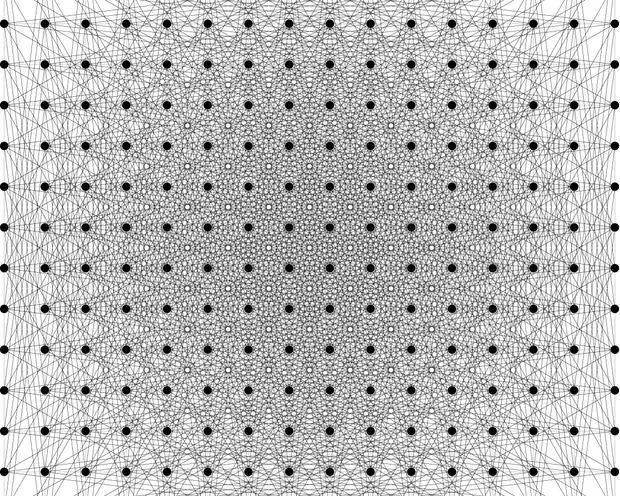
For nearly a century, the Erdős Unit Distance Conjecture has stood as a massive, legendary barrier in the field of discrete geometry. Formulated by the prolific mathematician Paul Erdős, the problem dictates the maximum number of times a specific unit distance can occur between a finite set of points in a two-dimensional space. Human mathematicians have spent decades publishing dense, incremental geometric papers trying to crack its absolute boundaries, only to hit a wall of overwhelming structural complexity.
OpenAI’s breakthrough model approached the problem not by guessing strings of text, but by actively synthesizing a highly complex, multidimensional geometric counterexample that mathematically shatters the premise of the conjecture.
The resulting proof was so logically dense that it required external validation from a panel of the world’s leading academic minds. According to official verification reports, a Fields Medalist checked the synthetic layout and confirmed that the model’s mathematical execution is completely flawless, marking a monumental paradigm shift in how humanity solves structural science problems.
2. Unthrottled Concurrency via Frontier Cloud Ecosystems
Running a mathematical logic tree of this magnitude requires a staggering amount of compute overhead and real-time bandwidth. To prevent the massive systemic chokepoints that usually freeze up standard computing models when handling multi-step reasoning problems, the underlying infrastructure relies on extreme hardware optimization.
This milestone highlights the absolute necessity of elite system integration. Whether you are running a high-performance deep learning platform or measuring the raw processing capabilities of local hardware setups—such as the advanced cooling arrays mapped out in our ASUS ROG Strix Scar 18 analysis—uncompromised memory bandwidth is what prevents severe thermal or data degradation under stress.
OpenAI’s historical run proves that when computing frameworks are perfectly matched with next-generation optimization software, the ceiling for raw processing velocity scales up exponentially.
3. Instant Corporate Integration: Moving Beyond Isolated APIs
Historically, when a breakthrough model launched, enterprises had to wait months for complex licensing and custom security clearances just to test the code. OpenAI is aggressively bypassing this commercial delay by launching its frontier models—including its newest programming agent configurations—straight into major global cloud ecosystems.
This means development teams can now access elite reasoning models directly through the exact same secure APIs, identity access management controls, and security firewalls they already use for day-to-day operations.
This frictionless deployment method mirrors what we have come to love about elite consumer software layouts. If you track our coverage of seamless platform performance, such as the unified system software detailed in our comprehensive SteamOS 3.8.6 System Performance Analysis, you understand how vital a zero-friction user interface is to maximizing true operational efficiency.
4. Acoustic and Spatial Telemetry: Mapping Complex Math
An underrated element of this geometric breakthrough is how the AI model translates abstract spatial properties into clear data streams. The network maps multidimensional point variables across a simulated architectural environment, tracking geometric hazards and relational vectors much like a tracking program navigates a physical room.
This intense level of spatial mapping demands an acute awareness of tracking accuracy. We see a highly similar reliance on spatial mapping precision when evaluating premium audio gear; for example, checking out the detailed frequency separation inside our Logitech G Pro X 2 Lightspeed review reveals how crucial pixel-perfect accuracy is to defining position. By treating mathematical formulas as physical landscapes, the model visualizes variables cleanly to execute its logic loops with zero systemic error.
5. Tracing the Multi-Generational Engineering Jump
Staring at an AI engine capable of out-thinking the brightest human minds in pure geometry highlights just how beautifully computing has evolved over the last decade. There was a time when “advanced software” simply meant rendering basic pixels or processing static text equations on a flat, low-contrast monitor.
We can chart this historical engineering leap clearly by tracking old-school mobile panel layouts; looking back at our classic LG G6 review reveals how far data layout, processing speed, and visual rendering parameters have progressed. We went from small consumer screens struggling to load compressed, flat web pages cleanly to remote cloud clusters mapping out the foundational laws of mathematics in real time.
The Verdict: The Era of AI Discovery Has Arrived
OpenAI’s June 4 announcement marks a bold, definitive milestone for the tech industry. By proving that a machine can solve a math problem that stood unconquered for 80 years, the frontier model landscape has officially graduated from a neat productivity tool to an absolute engine of historical academic progress.
Pros
- True Mathematical Originality: Becomes the first model to successfully disprove a landmark historical conjecture.
- Human-Verified Logic: Flawless proof architecture confirmed directly by a Fields Medal winner.
- Immediate API Deployment: Enterprise-ready integration removes typical corporate wait times.
- Unrivaled Multi-Step Reasoning: Demonstrates elite task decomposition without falling into loops.
Cons
- Extreme Compute Demands: Requires massive distributed cloud clusters to run intense logic paths.
- Niche Academic Language: The raw outputs are incredibly dense, requiring top-tier human experts to translate into practical real-world applications.
For additional live structural updates, official research whitepapers, and behind-the-scenes developer logs regarding this math milestone, you can explore the official OpenAI Research Newsroom to see how the next phase of human knowledge is being written!
What do you think?
Does this monumental mathematical breakthrough prove that AI models are starting to exhibit genuine reasoning capabilities, or do you view this as an elite form of brute-force computational statistics? Let us know your thoughts in the comment section below!