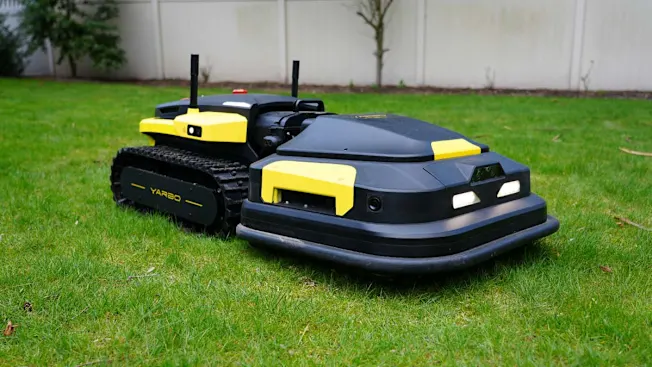
Yarbo M Series: The One Robot That Replaces Your Entire Yard Crew
Yarbo M Series: Stop filling your garage with seasonal machines. This modular robot replaces your entire yard crew by swapping attachments for mowing, snow clearing, leaf collection, and trimming.

Your garage is full of seasonal machines that sit idle for most of the year. A lawn mower that only works three months. A snow blower gathering dust from April to November. A leaf blower you pull out twice a fall. An edge trimmer you forget you even own.
Yarbo looked at this wasteful reality and built something radically different: the M Series, a modular yard robot that swaps attachments to handle every seasonal job on one platform. Instead of four separate machines, you get one autonomous core unit with modules for mowing, snow clearing, leaf collection, and trimming.
After debuting at CES 2026 and launching on Kickstarter shortly after, the M Series is shipping now. This isn’t vaporware or a distant promise. It’s a fully realized product tackling the year-round yard maintenance challenge that nobody else has solved.
The Platform: One Core, Unlimited Yard Work
At the heart of the M Series sits a tracked chassis powered by a 6 TOPS AI chip handling navigation. The core unit measures 36.7 x 21.3 x 13.5 inches overall, compact enough to fit through standard side gates and store in a typical garage bay.
Two battery configurations split the system’s performance tier. The M10 version runs a 10Ah battery with dual 150W motors, covering up to 1 acre per day with approximately 85 minutes of runtime per charge. The M20 bumps power to dual 300W motors with a 20Ah battery, extending coverage to 1.5 acres daily and 110 minutes per charge.
For properties with challenging terrain or lots of tree cover, the M20i adds LiDAR + RTK navigation for complex yards and night operations. That upgrade matters if you’ve got shaded areas, uneven ground, or want the robot working after dark when you’re not using the yard.
The tracked drive system handles slopes up to 70% (35 degrees), which means genuinely steep hills that would cause wheeled robots to slip, sink, or get stuck. It clears vertical obstacles up to 2 inches, moving smoothly over roots, stones, and garden edges without getting hung up.
Wire-Free Setup Changes Everything
Traditional robotic mowers require buried boundary cables. You spend a weekend trenching perimeter wire around your entire property, dealing with tree roots, irrigation lines, and the constant worry about accidentally cutting the wire months later when planting something new.
Yarbo eliminates that entire nightmare with wire-free setup using LiDAR, cameras, and bumper sensors to build its own yard map. The system uses stereo vision technology and ODOM for precise navigation, maintaining centimeter-level accuracy even when RTK signals weaken under buildings or trees.
The dual antennas on the core unit enable this precision across all modules and attachments. When the Yarbo maps your yard, every module benefits from that same accurate boundary knowledge. No manual mapping walks. No signal interference from structures. The robot figures it out autonomously.
This isn’t just convenience. It’s the difference between a product most homeowners can actually deploy versus one that sits in the box because the installation process feels too daunting.
The Mower Module: Professional Cut, Zero Effort
The M1 mower attachment features a 15.7-inch cutting width with adjustable height from 1.2 to 4 inches. Blade configuration differs by battery tier: the 10Ah version uses cutting discs with multiple razor blades, while the 20Ah version deploys straight blades for cleaner cuts on thicker grass.
Yarbo offers two blade systems for different grass conditions. One set features dual cutting discs, each equipped with 5 razor blades, reinforced to enhance durability and prevent clogging. The other set consists of two straight blades made from SK85 high-carbon steel, offering greater strength for dense, tough warm-season grasses.
The system handles all-season grasses with particular ease on dense varieties like Zoysia, Buffalo Grass, St. Augustine, Bermuda, and Kikuyu that challenge conventional robotic mowers. The 300W motors on the M20 power through wet, thick grass and overgrown conditions that would bog down lesser machines.
Coverage specs are competitive with standalone premium robotic mowers. On a full charge (100% to 0%), Yarbo covers up to 0.43 acres. In daily operation, it runs seven mowing cycles, each covering 0.25 acres, for a total of up to 6 acres per week when mowing twice weekly as recommended for lawn health.
The mower automatically returns to its charging station at 20% battery, charges from 20% to 80% in about 90 minutes, then resumes mowing without manual intervention. This efficient charge cycle enables true hands-off operation across large properties.
Snow Blower: Autonomous Winter Clearing
The S1 snow blower module transforms the same core unit into an autonomous snow removal system designed to tackle fresh and wet snow, even on gravel surfaces. It’s quiet enough for night operation, solving one of the biggest problems with traditional gas-powered snow blowers: you can’t run them at 6 AM without waking the entire neighborhood.
Zero-emission electric motors deliver steady performance with less noise, lower maintenance, and no fuel costs compared to gas-powered alternatives. The tracked chassis that handles steep slopes during mowing season provides the same traction advantage in snow, maintaining grip where wheeled systems fail.
The Yarbo app lets you plan snow removal zones, set automated schedules, and monitor real-time progress. When snow is forecast, the system can trigger automatically based on weather data, clearing your driveway before you wake up.
Leaf Blower & Trimmer: Completing the Ecosystem
The B1 blower module handles leaf collection and debris clearing during fall months. Instead of manually raking or hauling out a separate leaf blower, the same Yarbo core switches modules and handles the job autonomously.
The upcoming trimmer attachment (currently in development) will complete the autonomous lawn care system by tackling edges and detail work with precision. This addresses one of the remaining manual touchpoints in robotic lawn care: most systems mow well but miss the edges, requiring homeowners to follow up with manual trimming.
When the trimmer ships, Yarbo becomes genuinely comprehensive. Mowing, trimming, leaf clearing, and snow removal all from one platform, all autonomous, all controlled through the same app.
The Economics: One Platform vs Four Machines
A quality robotic mower costs $1,500-$3,000. A snow blower runs $800-$1,500. A leaf blower adds $200-$500. An edge trimmer costs $150-$400. You’re looking at $2,650-$5,400 for separate machines, plus the garage space to store them.
The Yarbo M Series typically ranges from $3,500 to $4,900 depending on configuration, battery size, and chosen attachments. That’s competitive with buying multiple single-purpose machines, but you get a unified platform with shared intelligence, coordinated charging, and modular expansion.
More importantly, you’re not locked into one seasonal use case. If you buy a premium robotic mower and then move to a property that doesn’t need it, that $3,000 investment becomes deadweight. With Yarbo’s modular design, you adapt the platform to your new property’s needs by swapping modules.
The battery and motor investment carries across all seasonal tasks. The navigation mapping works for every module. The charging infrastructure supports the entire ecosystem. It’s genuinely more efficient than buying separate specialized machines.
Smart Features & Continuous Updates
The Yarbo app offers full control: plan zones, manage coverage areas, set automated schedules, monitor real-time progress, and manually operate the system when needed. Optional remote teleoperation lets you tap into the unit from anywhere and use onboard cameras to manually drive when autonomy proves problematic.
Security features include round-the-clock monitoring with intruder detection, immediate alerts, and live feed access for real-time yard surveillance. The core unit essentially doubles as a mobile security camera when not actively working.
Since launch, Yarbo has pushed over a dozen firmware and app updates (v2.0 to v3.15), bringing improved performance, stability, and new features to every user. The modules themselves have received hardware upgrades based on field testing, increasing performance, durability, and efficiency.
This continuous improvement approach means the Yarbo you buy today will get better over time through software updates, not become obsolete when next year’s model ships.
Real-World Performance: What Users Report
Initial reviews highlight the M Series’ strengths in typical suburban yards. The wire-free setup works as advertised, with users reporting quick mapping and reliable boundary recognition. The tracked drive system handles slopes and rough terrain that wheeled competitors struggle with.
The mowing performance on typical lawns provides consistent, professional-looking cuts. Some users note that performance on severely overgrown grass can vary, though the straight blade option on the M20 specifically addresses thick, dense growth.
The smart obstacle detection system proves effective in real-world conditions, though like any robotic system, complex scenarios can present challenges. The bumper sensors and cameras work together to avoid collisions while maintaining close edge proximity.
Battery performance meets specs, with users confirming the stated coverage and runtime figures. The automatic return-to-charge functionality works reliably, ensuring the system stays operational without manual intervention.
Who Should Buy the Yarbo M Series
This platform makes sense for homeowners with:
Large or complex properties: If you’ve got 1+ acres with varied terrain, slopes, or tree cover, Yarbo’s capabilities justify the investment. Smaller, flat yards might be better served by simpler, cheaper solutions.
Year-round yard maintenance needs: The modular value proposition only pays off if you actually need multiple seasonal tools. If you live somewhere without snow, the snow blower module adds no value.
Preference for automation over manual work: Some people enjoy lawn care. If you’re in that camp, Yarbo isn’t for you. This is for people who view yard work as a chore to be eliminated, not a weekend hobby.
Willingness to adopt emerging technology: Yarbo is a relatively new company with an evolving product. Early adopters get the latest innovation but also the potential growing pains of a young platform.
The Bigger Picture: Modular Robotics Done Right
Most robotic yard tools remain single-purpose machines. You buy a robotic mower, it mows. A year later you buy a robotic snow blower, it blows snow. They don’t talk to each other. They don’t share infrastructure. They each require separate charging, separate apps, separate storage.
Yarbo’s modular approach represents a fundamentally different philosophy: invest in a smart core platform once, then expand functionality by adding modules as needed. The battery, motors, navigation, and intelligence get reused across every task.
This mirrors how professional landscaping companies operate. They don’t own separate trucks for mowing and snow removal. They own trucks and swap attachments. Yarbo applies that same practical efficiency to residential automation.
For homeowners tired of juggling multiple seasonal machines, the M Series offers a genuinely different solution. One robot. Four seasons. Zero wires. That’s the pitch, and for the right property, it delivers exactly that.
The Yarbo M Series is available now at yarbo.com, with the core unit and modules shipping within 3-8 business days. Pricing varies by configuration, but expect $3,500-$4,900 for a complete setup with your choice of modules.