Razer Blade 16 (2026) Review: The Most Powerful Thin Gaming Laptop Money Can Buy
The Razer Blade 16 2026 packs an RTX 5090 into a 14.9mm chassis — but does the $4,900 price tag make sense?

There is a very specific kind of person the Razer Blade 16 is built for. Not the person who wants the most gaming performance per dollar — they should buy an ASUS ROG or an Alienware. Not the person who wants a daily driver laptop that can play games on the side — they should buy an XPS or a MacBook. The Razer Blade 16 is built for the person who refuses to choose between a premium ultrabook and a genuine gaming powerhouse, and is willing to pay a serious price to avoid making that compromise.
The 2026 Blade 16 is the latest iteration of that idea. Featuring 33% more processing cores, the fastest available memory with LPDDR5X-9600MHz, and up to a 60% boost in battery efficiency, the new Blade 16 remains the definitive ultra-portable flagship in Razer’s family of high-performance Blade gaming laptops. HyperAI
But there are genuine questions this generation raises that deserve honest answers. Is the Intel switch from last year’s AMD processor actually an upgrade? Does the RTX 5090 live up to the hype at this price? And can a laptop this thin really be called a proper gaming machine without serious thermal compromise?
This is the full review.
Design and Build: Still the Best-Looking Gaming Laptop Made
Let’s start with the thing that has always defined the Blade series — the chassis. And here, the 2026 model delivers exactly what you’d expect: no change, no compromise, and no reason to change something that was already industry-leading.
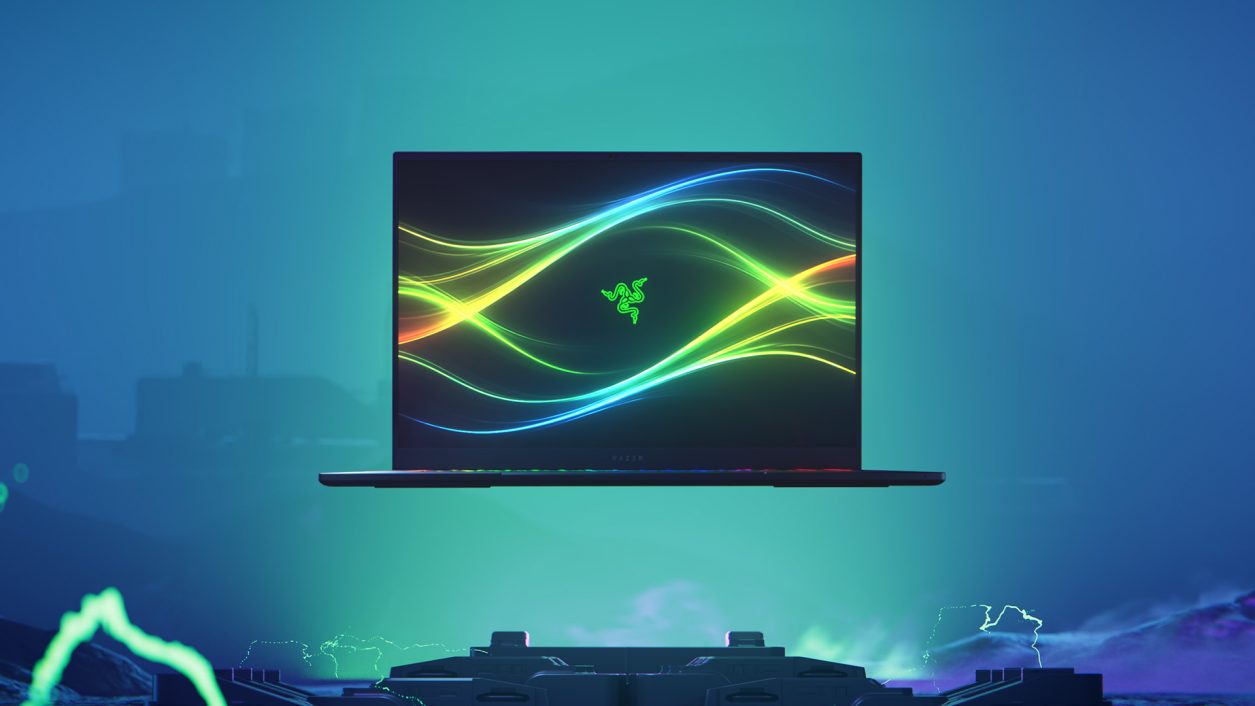
Despite the high performance packed inside, the housing remains extremely thin at just 14.9mm and weighs around 2.14kg. For a laptop packing an RTX 5090 — a GPU that in desktop form requires a case the size of a small refrigerator — that is a genuinely remarkable engineering achievement. The all-CNC machined aluminum chassis in matte black looks and feels more like a premium business ultrabook than a gaming laptop, which is entirely the point. Growthhq
The keyboard is comfortable, the trackpad is one of the best on any Windows laptop, and the build quality is tight enough that nothing flexes or creaks under pressure. Razer has been refining this chassis for years and the 2026 model is the most polished version yet. If you put it in a coffee shop next to a Dell XPS 16, most people couldn’t tell which one was a $5,000 gaming laptop.
Display: Brighter, Better, Class-Leading
The OLED display on the 2026 Blade 16 is one of the best panels you will find on any laptop at any price, and it has received a meaningful upgrade over last year.
The Blade 16 (2026) models are rated at up to 500 nits in standard mode and up to 1,100 nits in HDR mode. The 2025 models were rated at up to 400 nits in standard mode and up to 500 nits in HDR mode. That HDR jump from 500 nits to 1,100 nits is enormous — more than double — and it transforms the HDR gaming and content experience into something that genuinely competes with standalone OLED monitors. Tom’s Guide
The 16-inch panel runs at 2560×1600 QHD+ resolution with a 240Hz refresh rate. In practice this means games look razor sharp, motion is fluid in a way that 60Hz displays can never replicate, and OLED’s signature strengths — perfect blacks, infinite contrast, colors that seem to glow from within — are on full display every time you open a game or a film.
For content creators who also game, the color accuracy on this panel is exceptional. The display covers virtually 100% of the DCI-P3 color space, meaning video editing, photo retouching, and color grading work on the Blade 16 can be trusted — an unusual claim for a gaming laptop that most professional creative tools require a dedicated monitor to achieve.
Performance: RTX 5090 + Intel Core Ultra 9 — What the Numbers Say
This is where the 2026 Blade 16 gets interesting — and slightly complicated. The headline specs are undeniably impressive.
At the core of the new Blade 16 is the Intel Core Ultra 9 386H, featuring 16 cores and up to 4.9GHz boost clock. Razer claims a 33% increase in core count versus the previous generation, translating to stronger performance across gaming, content creation, and AI workloads. There’s also an integrated NPU capable of up to 50 TOPS, enabling faster on-device AI tasks like image generation and live translation. Eastern Herald
The NPU is a new addition that deserves mention. With 50 TOPS of dedicated AI processing power, the Blade 16 qualifies as a Copilot+ PC — meaning Windows AI features, real-time translation, local image generation, and AI-enhanced applications all run directly on device without needing a cloud connection. For a gaming laptop, this is genuinely useful for content creators who use AI-assisted editing tools.
At the core sits Intel’s Core Ultra 9 386H processor, featuring a 16-core design that can boost up to 4.9GHz — a notable increase in core count compared to the previous generation. Gizmodo
However, real-world benchmarks reveal a nuance that prospective buyers need to understand. The Razer Blade 16 2026 offers slower CPU performance in multi-core workloads than the 2025 Blade 16, which featured the AMD Ryzen AI 9 HX 370. In Blender and Houdini, Hardware Canucks reports an 8% to 13% performance regression for the Razer Blade 16 2026. In video editing, the Blade 16 2026 beats the 2025 version in Resolve but falls behind in Premiere Pro. Gear Patrol
This is a significant finding. The Intel Core Ultra 9 386H is not a straight upgrade over last year’s AMD chip for all workloads — it is a trade-off. For gaming, the Intel chip performs similarly or slightly better due to improved GPU driver optimization. For heavy multi-threaded creative work, last year’s AMD configuration was actually faster.
The “Performance” profile is where the Blade 16 2026 shines, as the laptop consumes much lower power at 57W versus 74W and runs cooler at 75°C versus 79°C without any change in fan noise. That efficiency improvement is real and meaningful — the 2026 Blade 16 runs cooler and quieter than its predecessor at similar performance levels, which is a genuine quality-of-life upgrade over long gaming sessions. Gear Patrol
Gaming Performance: RTX 5090 in a 14.9mm Chassis
The GPU story is cleaner than the CPU story. The RTX 5090 Laptop GPU is the most powerful mobile graphics processor Nvidia has ever made, and the Blade 16 2026 gives it a proper platform.
The Razer Blade 16 2026 packs RTX 5090 laptop performance inside a slim body, supporting both gameplay and encoding simultaneously for streamers — genuine desktop-class content creation in a portable form factor. Glass Almanac
In gaming benchmarks, the RTX 5090 configuration handles every current game at QHD+ resolution with maximum settings at well above 60fps. With DLSS 4 and Frame Generation enabled, titles like Cyberpunk 2077, Alan Wake 2, and Black Myth: Wukong push past 100fps at maximum settings on the native 240Hz panel — performance that would have required a desktop PC just two years ago.
The Razer Blade 16 stuns thanks to its design, OLED panel, and strong gaming performance. While expensive, you’re getting a true premium gaming experience. Gear Patrol
The one caveat is that Nvidia’s Blackwell laptop GPU drivers are still being refined. Some users have reported occasional stuttering in specific titles, particularly older games that haven’t been optimized for the new architecture. These are driver issues that will be resolved through updates, but it is worth knowing if you play a specific title that hasn’t been patched yet.
Battery Life: Finally, a Gaming Laptop You Can Use Away From a Desk
This is the area where the 2026 Blade 16 most dramatically improves over its predecessors — and it deserves significant credit.
In battery life testing involving continuous Wi-Fi web surfing with the display set to 150 nits, the Razer Blade 16 (2026) lasted nearly 13 hours — almost as long as the Dell XPS 16, which is extremely impressive for a gaming laptop. Gear Patrol
The Blade 16 2026 lasted 17 hours and 20 minutes in the web browsing test — a 70% improvement over the previous model. A 70% battery life improvement in a single generation is extraordinary. It transforms the Blade 16 from a laptop that technically has a battery into one that can genuinely survive a full work day without a charger. Gear Patrol
The caveat, as with all gaming laptops, is that active gaming drains the battery fast. Gaming battery life was just under two hours, which is typical for a gaming laptop. If you’re gaming unplugged, two hours is the realistic ceiling regardless of what the productivity numbers say. But for the student, professional, or creator who games in the evening — the 13-hour workday battery means the charger stays in the bag all day and only comes out when it’s time to play. Gear Patrol
Connectivity: Future-Proofed
The 2026 Blade 16 gets a future-ready connectivity suite, including Thunderbolt 5, Wi-Fi 7, and Bluetooth 6.0. There’s also a full set of ports, from USB-A to HDMI 2.1 and an SD card reader. Eastern Herald
Thunderbolt 5 is a meaningful upgrade over Thunderbolt 4, offering up to 120Gbps of downstream bandwidth — fast enough to drive an 8K external monitor or connect an external GPU enclosure. Wi-Fi 7 provides the lowest latency wireless gaming experience currently available, and in practice the Blade 16’s wireless performance is indistinguishable from a wired ethernet connection in most gaming scenarios.
The HDMI 2.1 port supports 4K at 120Hz for connection to external displays or televisions — making the Blade 16 a legitimate living room gaming machine when needed, not just a desk setup.
Audio: A Real Upgrade
The package is rounded off by a revised 6-speaker system with THX Spatial Audio+, which enables virtual 7.1.4 surround sound via headphones for the first time. Precise localization can be an advantage, especially in competitive games. Growthhq
Gaming laptops are not known for audio quality. The Blade 16 2026 is the exception. The six-speaker system produces genuinely impressive stereo imaging for a thin chassis, and THX Spatial Audio+ through headphones delivers directional audio that gives you a real competitive edge in games where sound positioning matters — footsteps in tactical shooters, ambient audio cues in horror games, directional environmental sound in open-world titles.
Price: Premium in Every Sense
Here is where the Blade 16 2026 asks the hardest question — and demands the most honest answer.
The RTX 5080 configuration with 64GB memory is listed at $4,699.99, while the RTX 5090 version reaches $5,599.99. Whereas the 2025 Blade 16 with the same GPU launched at $4,500, the 2026 model with the same specifications launches at $4,900 — a price increase that can be harder to justify for a model that already retails higher than most competitors. GizmodoWareable
You are paying a significant premium for the Razer brand, the chassis quality, the OLED display, and the form factor. Competitors like the ASUS ROG Zephyrus G16 offer similar RTX 5090 performance at meaningfully lower prices. The trade-off is that they are thicker, heavier, or sacrifice premium build quality to hit that price point.
Whether the Blade 16 premium is worth it comes down to one question: how much do you value portability and aesthetics alongside performance? If the answer is “a lot” — the Blade 16 2026 is unmatched. If the answer is “not that much” — there are better value options.
The Verdict
Faster memory, better HDR support, slightly cooler core temperatures, and a more efficient CPU all lead to improved gaming performance from the same GeForce RTX 5090 GPU and chassis design. Battery life in particular is much longer this time around, which may attract more students or frequent travelers. Wareable
The Razer Blade 16 2026 is not the laptop to buy if you want the most gaming performance per dollar. It never has been. It is the laptop to buy if you want the best possible combination of premium design, OLED display quality, RTX 5090 gaming performance, and 13-hour productivity battery life in a 14.9mm chassis that you will not be embarrassed to pull out in a boardroom or a coffee shop.
That combination has no real competition. And at $4,900 for the top configuration, it had better not.
Forantech Rating: 8.6 / 10
Buy if: You want flagship gaming performance in an ultra-slim, premium design and battery life matters to you.
Skip if: You prioritize raw multi-core CPU performance, upgrade flexibility, or maximum value per dollar.
Starting Price: $2,399 (RTX 5060) | $3,999 (RTX 5080) | $4,900 (RTX 5090)